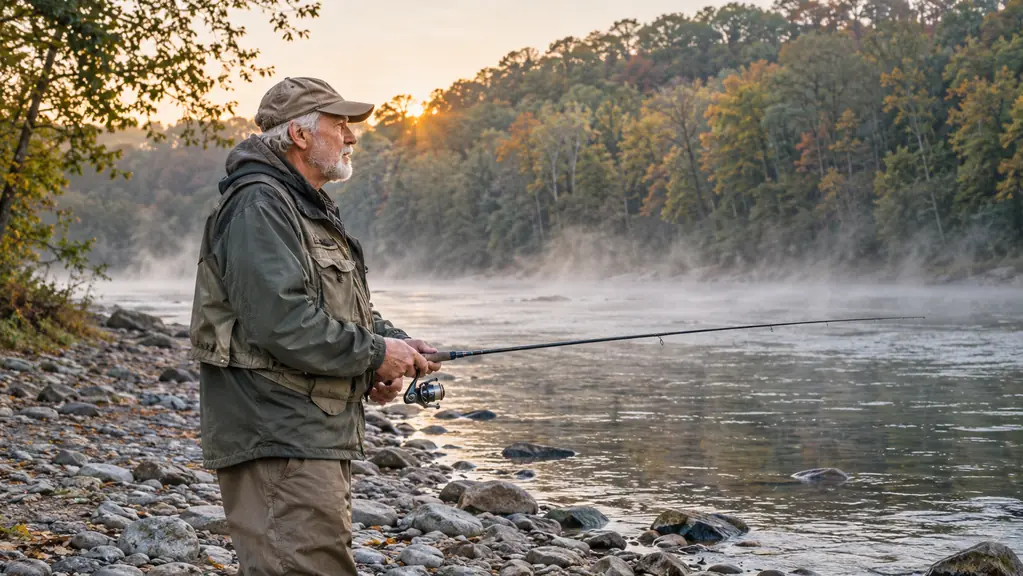
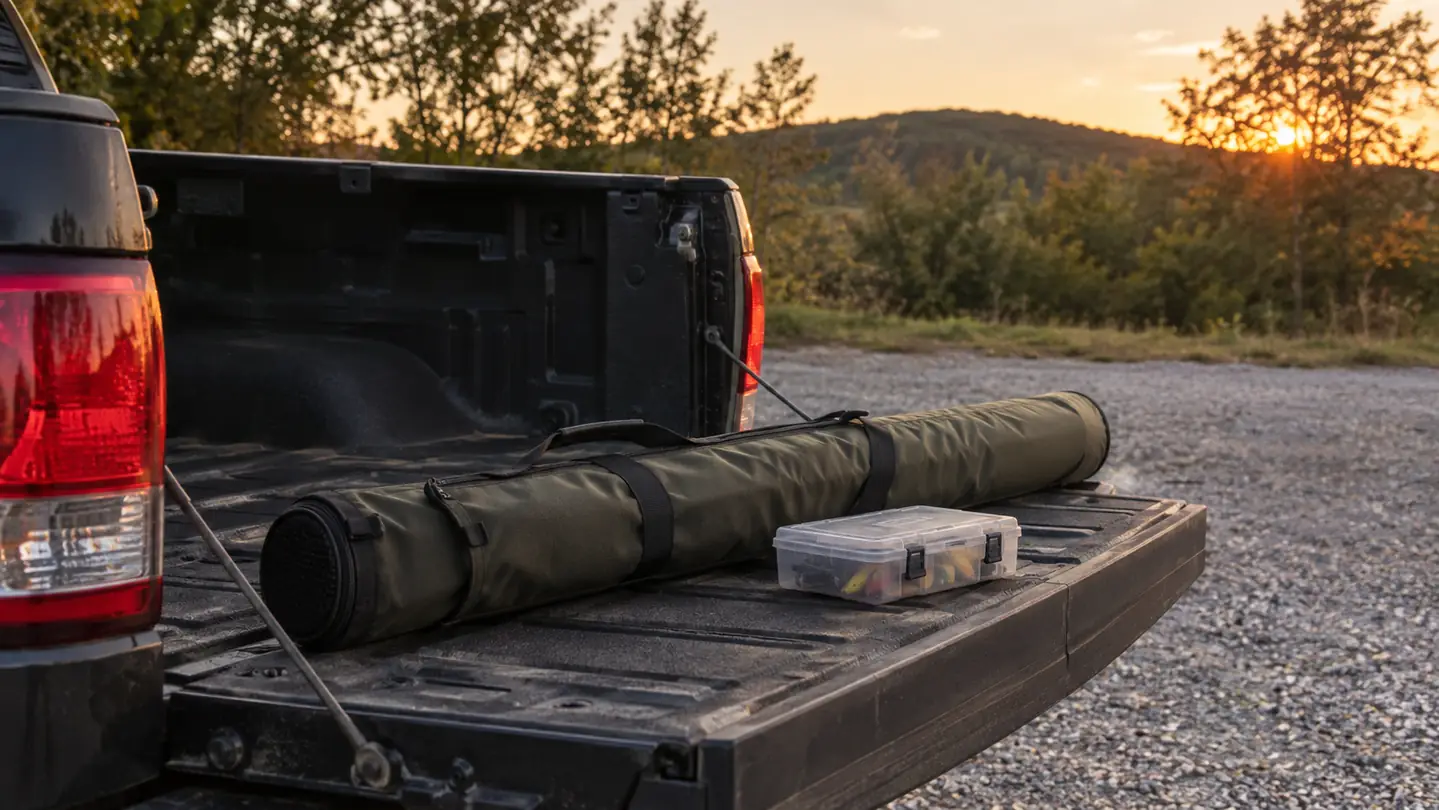
I bought the PLUSINNO telescopic combo in March 2026 for a reason that has nothing to do with how it casts. My old spinning rod lives in the jon boat and always has. It is long enough that it will not lie down in the cab of a pickup without leaning against the back glass, which means it leans on Ray for the whole drive. Ray does not fish. He rides along and he does not say much, but a rod butt in the shoulder is a thing a man notices by the second hour. The PLUSINNO comes apart into a carrier case that goes behind the seat and stays there. That was the entire argument for buying it, and I would rather say so up front than dress it up as something it is not.
Two trips so far, the Smoky Mountains in May and the Arkansas Ozarks in August. Both times I bought a non-resident license before we left and both times I fished from public bank. Travel fishing is not boat fishing. You are not covering water or running to a brush pile you marked last fall. You are standing where the state lets you stand, throwing something small at whatever is in front of you, and if you get two hours before Ray starts looking for breakfast, you got two hours. The gear should fit that kind of fishing. Most of the advice you will read does not.
A rod that rides behind the seat instead of against the back glass
The PLUSINNO kit comes in a carrier case with the rod, a 3000 size reel, line, and a starter set of lures and hooks. I did not have to buy a thing to fish the first evening.
Amazon Check Today's Price on Amazon →Step 1: Pick water you can walk to, not water you can launch into
The first mistake I made was planning around water I knew from the boat. Lake Barkley is twenty minutes from my house and I have fished it for years, but on a road trip you are not pulling a fourteen foot jon boat and you are not paying for a slip. What you want is bank access. A wildlife management area with a gravel lot, a tailwater below a dam, a city lake with a walking path around it. Look for the words public fishing access, not boat ramp. Those are two different lists and only one of them helps you.
I spent one evening on the state agency site before the Smokies trip doing exactly that, and it was the most useful hour of the whole plan. Some of those places have a mowed path and a sign. Some of them are a pull-off on a county road with a steep muddy bank and nowhere to stand. The listing does not tell you which is which. On the Arkansas trip I drove past two of them the evening before and it saved me a wasted morning. The first spot on my list was a gravel pull-off with a bank that dropped four feet straight down to the water, no path and no handhold. The second was a quarter mile farther, past a gate, with a mowed strip and shallow steps down to a flat rock shelf. Same listing page. Two different places. Look at the bank with your own eyes instead of finding out in the dark with a rod in your hand.
The PLUSINNO rod suits that kind of fishing. The one I bought is 5.91 feet with medium power, and the whole combo weighs 1.2 pounds, light enough to carry a half mile down a bank without thinking about it. It is long enough to get a cast past the shallow shelf at your feet and short enough that you can cast with alders at your back. That is most of what bank fishing asks for.
Step 2: Get legal before you get tackle
Every state I have fished wants a license, and every state wants it before you wet a line, not after. A non-resident license costs more than a resident one, and several states sell a short version, three days or seven days, which is what you want for a trip. I bought mine online the week before we left and kept a copy on my phone and a printed one in my wallet. Nobody asked to see it. That is not the point of having it. The Arkansas license was the three-day kind, bought online the week before we left, and I printed it at home so I had paper in my pocket on the bank.
Read the rules for the water you picked, not the rules for the state in general. Some places want an extra stamp for trout. Some water is catch and release only, or artificial lures only, or closed on certain days. The stretch of Ozarks river I had picked out was artificial lures only, which suited me fine, since the kit is lures anyway. A few public banks are closed to fishing entirely in summer because they are swimming areas. I have walked down a nice looking bank and then read the sign at the top of it. Better to read the sign first.
One thing people get wrong. If somebody holds a rod while you tie on, in most states that person is fishing and needs a license. Check before you hand a rod over, because a game warden will not care that the rod was only being held for a minute.
Step 3: Learn the one quirk in your own driveway
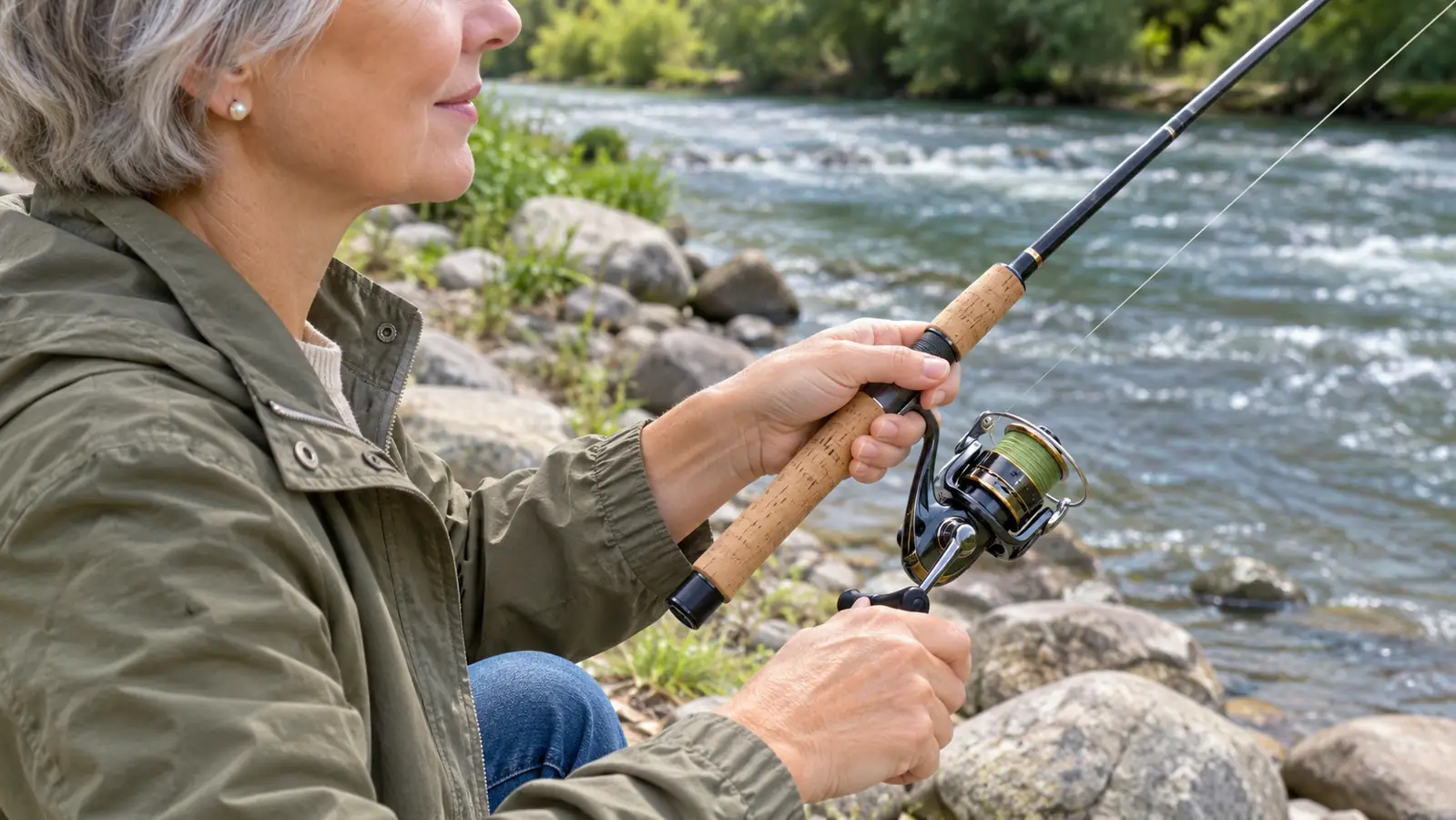
A telescopic rod is not complicated, but it has one habit that will cost you a fish if you meet it on the water for the first time. The sections slide out from the handle toward the tip and each one has to be seated, snug, all the way. A section that is not fully seated will slip back in during the cast. You feel the rod go soft, you hear a click, and the lure lands about fifteen feet in front of you. Extend it a section at a time and check each joint with your hand before you move to the next.
The reel is a 3000 size with a 5.2 gear ratio and a handle that collapses. The handle goes left or right, whichever you want, and it folds down so the case will close over it. Set the drag before you leave the driveway. The reel is rated to 11 pounds of maximum drag and you do not need anything close to that for the fish you will catch from a bank. Pull line off the spool by hand. If it comes off hard, back the drag off.
Then cast in the yard. Ten casts on grass will tell you more than a page of instructions. I did mine on a Saturday morning in the driveway with the truck idling, kneeling on the gravel, extending and collapsing the rod eleven or twelve times until my hands knew the order of the sections without me watching them. The first three tries I missed a joint and did not know it until I wiggled the tip. That first cast on the water should not be your first cast with that rod. I have made that mistake with other gear and it always costs an hour of daylight.
Step 4: Rig light and keep the tackle box small
The reel is rated for 10 pound monofilament and it holds more line than a bank angler will ever need. That rating is fine. Ten pound mono will handle the trout and small bass you find from public access, and it will not spook fish in clear water the way heavier line can. The reel picks up 28.9 inches of line per turn of the handle, quick enough to work a small spinner without the lure spinning on you.
I carry one StowAway box on the road, the one with hooks, split shot, swivels and terminal tackle, and nothing else. The kit came with lures and hooks of its own and those ride in the case. The crappie jigs stay home. The crankbaits stay home. If I cannot fish it from a bank in two hours, it stays in the garage, and I have not once wished for something I left behind.
When you get back to the truck, everything goes in the case and the case goes behind the seat. Loose hooks in a cab find carpet, and carpet does not give them back. That is the whole storage system and it has held for two trips.
Step 5: Fish the bank like a bank angler, not a boat angler
The cast that catches fish from a bank is usually parallel to it, not straight out. Fish sit along the edge of the shelf where shallow water drops off, and if you throw straight out you throw over them. Cast down the bank, let the lure swing, and bring it back along the drop. Work a stretch of bank, walk twenty steps, work the next stretch. The morning in Arkansas that worked, I fished one stretch maybe eighty yards long for close to two hours and never walked past it. Three small bass out of three pockets, all on the same cast angle.
In the Smokies I fished small spinners for trout and the whole game was upstream. Cast above where you think the fish is holding and let the current carry the lure down to him. In the Ozarks I fished small bass in the pockets behind rocks and laydowns, casting past the pocket and bringing the lure through it. Slow down more than feels natural. Bank fish see less pressure than boat fish, and they still are not in a hurry.
Keep the drag light and your feet quiet, and take the short session instead of the long one. Two hours on good water beats five hours of walking past it. Bring something to land a fish with, too. A steep bank is a poor place to land a fish, because you have nothing to scoop with and no way down to the water. Pick your landing spot before you cast, or carry a short net.
What Else Helps
A headlamp earns its place in the truck more than anything else I carry. Road trips put you on the water early or keep you there late, and tying a knot by feel in the dark is a young person's game. I keep a rechargeable one in the door pocket and run it on red while I am walking, so I am not walking blind for the first five minutes after I turn it off.
Beyond that, a pair of forceps and a set of clippers on a lanyard, a rag that is not one of Ray's good ones, and a towel in the cab for your hands. A wet hand on a rod handle is how a rod ends up in the river. Sunscreen and water, which sounds like advice off a pamphlet until you are sixty one and standing in the sun for three hours.
One more thing, and this one is not gear. Check the weather for the water you picked, not for the town you are sleeping in. Mountain water runs cold and rises fast, and a forecast from a valley town twenty miles away will not tell you that.
It is 5.91 feet and 1.2 pounds, and it comes apart into a case that lives behind a truck seat. That is the whole case for a telescopic rod, and on a road trip that is enough.
If your fishing happens on the way somewhere, this is the rod that fits the trip
Eight months and two road trips in, the PLUSINNO kit has done everything I asked of it and nothing it was not built for. Check the length and the line rating against the water you plan to fish, and skip it if what you really need is a boat rod.
Amazon Check Today's Price on Amazon →