
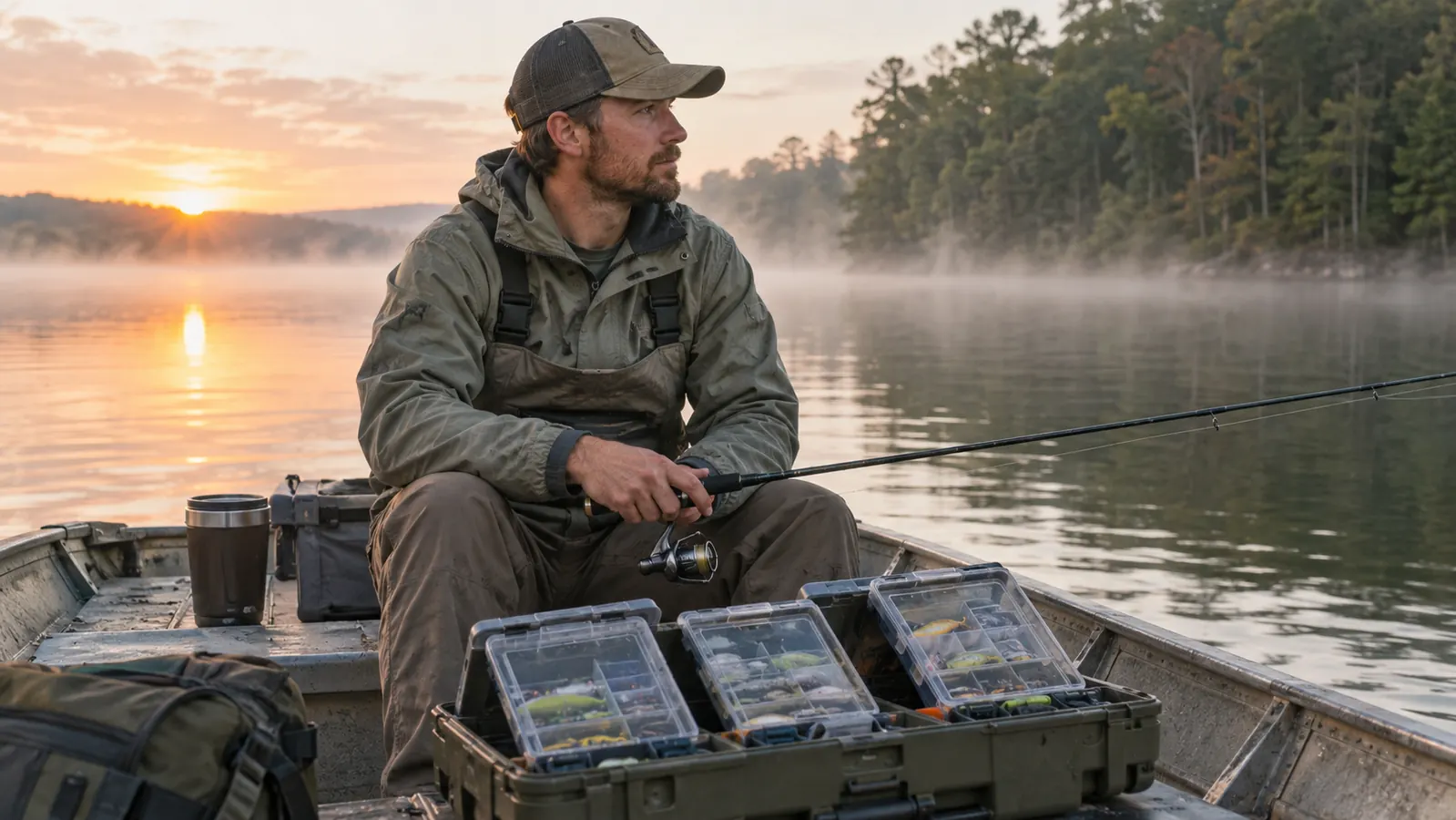
I bought the Plano angled tackle system in April 2024 for a plain reason: I was tired of digging. Before that I had one old metal box that belonged to my dad, and everything I owned went into it, crappie jigs beside crankbaits beside a knot of split shot, and every time I wanted a hook I had to lift half of it out and set it on the boat seat. Two and a half years later the Plano lives in the garage and rides in the jon boat on every trip to Lake Barkley. The metal box sits on a shelf now. I keep it out of respect, not out of use.
I am not a guide and I do not test gear for a living. I ran a taxidermy shop out of a converted garage for twenty years, which mostly taught me to look at how a thing is joined and finished before I trust it, and I have been fishing and hunting since my father started taking me out at twelve. So this is a long-term note from somebody who has opened the same lid a few hundred times, not a first-week impression. There is one part of this box I would change. I will get to it, but I am not going to lead with it, because on the whole the thing has done what I bought it to do.
The Quick Verdict
Hard sided, three StowAway boxes, and a fifteen degree angle that lets you see what you own without unpacking it. Two and a half years of boat and garage use with nothing cracked. It is heavy once it is full, and that is the honest trade.
Amazon Check Today's Price →Stop digging for a jig you know you packed
Three StowAway boxes tilted up at a fifteen degree angle inside a hard shell, so the lid comes up and the answer is right there. Mine has ridden in a jon boat since April 2024.
Amazon Check Today's Price on Amazon →How I've Used It
The box lives in the garage between trips, on a low shelf by the door, and it rides on the deck of the jon boat behind my seat when I launch at the public ramp on Barkley. That is a twenty minute drive from the house, so it is not a hard life. It is not a shelf life either. It gets lifted in and out, set down on bare aluminum, slid under the cover when the boat sits, and left in an unheated garage from November to March. Anything I keep my tackle in has to survive that without me thinking about it, and so far this one has.
What it changed was the order of things. Before, I would cut the motor at a brush pile and then spend four or five minutes hunting for the jig I wanted while the boat drifted off the spot. Now I lift the lid, look down at three boxes tilted up toward me, and put my hand on the right one. I am not going to claim that made me a better fisherman. It made me a faster one, and on a windy day on Barkley that is close to the same thing.
I fish crappie mostly, bass enough to keep me honest. My tackle is not complicated: jigs, soft plastics, a few crankbaits, hooks, weights, and the small terminal odds and ends that collect in every box. All of it fits with room to spare. I say that plainly because a lot of storage is sold on capacity it does not really have, and I have never once left something home because the Plano was full.
What It Replaced
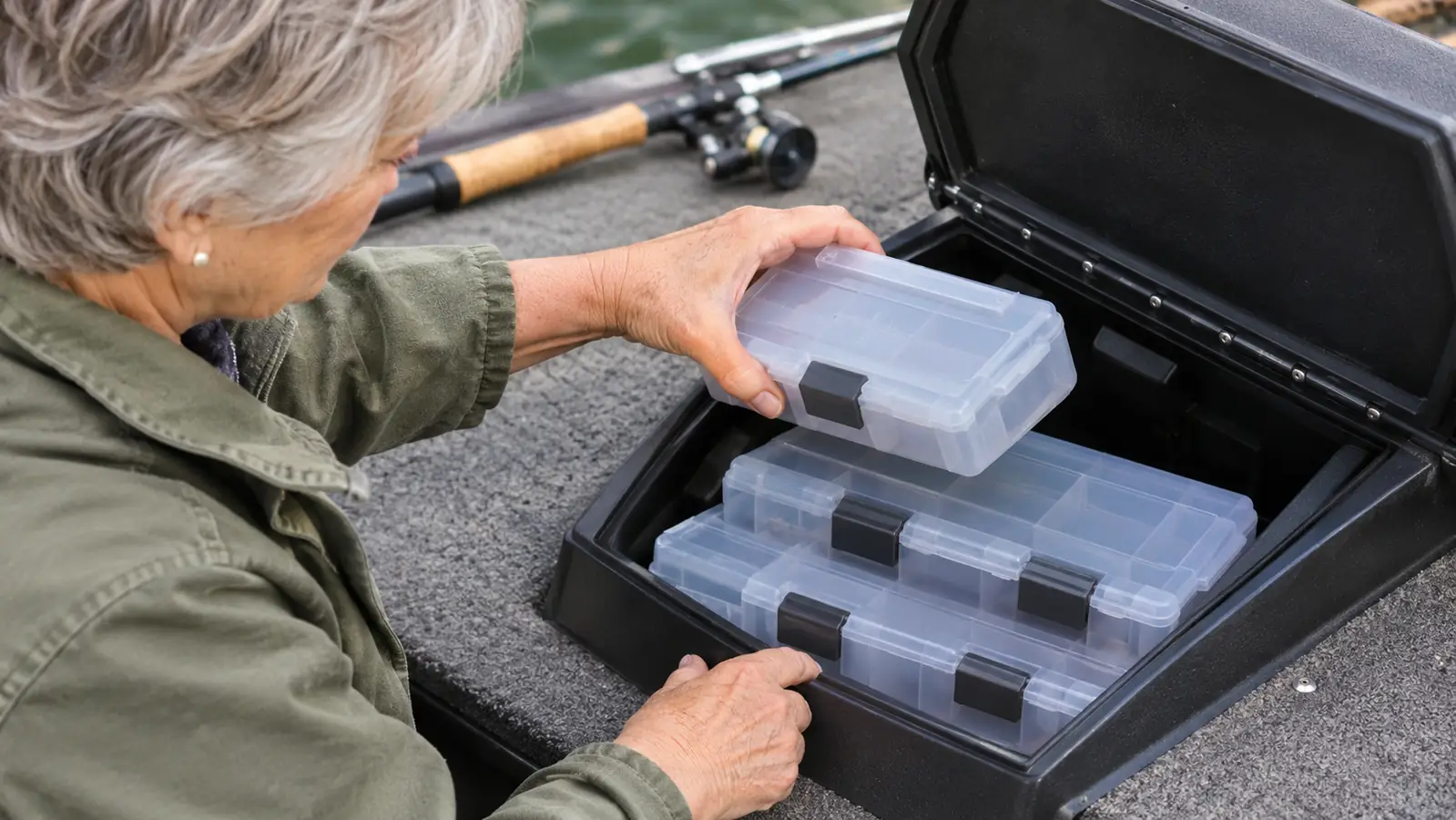
I want to be fair to the old metal box, because it held everything I owned for thirty years and it never let water in. But it was one compartment with a tray on top, and a tray on top of one compartment is where things go to be lost. I spent more time sorting that box than fishing out of it. When I finally moved everything into the Plano, it took one evening on the bench, and I found three things I had forgotten I owned, including a pack of jig heads I had bought twice because I could not find the first pack.
That first weekend is the part I remember. I dumped the metal box out, sorted lures into three piles, and put each pile in its own StowAway box. Nothing clever about it. But I could see all of it at once, and I have kept it that way for two and a half years, which is longer than any other organizing I have ever done. The old box is on a shelf in the garage and I do not miss it, though I would not get rid of it either.
Why the Fifteen Degree Angle Earns Its Keep
The feature in the name is the one that sold me. The main compartment holds the three StowAway boxes tilted at a fifteen degree angle, so the tops face up toward you instead of lying flat at the bottom of a well. On a listing that reads like a small thing. In a boat it is the entire point. Flat boxes give you a lid and a guess. These give you a look at the compartments without lifting anything out.
I keep a pair of readers in the boat now, and even with them a flat box has always meant a lean and a squint. The angled box means a look down. At first light, which is when I am usually on the water, that difference is the difference between fishing and fiddling while the boat slides off the brush pile you wanted to fish.
The DuraView covers do the same work from the other direction. Because you can see through them, I can check a box without opening it at all, and that matters more in cold weather than it does in July. When it is thirty eight degrees and my hands are stiff, I want to open exactly one box, not three.
Most of the sorting happens at home anyway. I lay the whole thing on the bench, pull all three boxes out, and restock what I used. That takes ten minutes at the tailgate and it is the ten minutes that keeps boat time from turning into a search.
What Two and a Half Years Did to It
Nothing has cracked, split or come apart. The shell is hard sided and it has taken the knocks you would expect from being set down on aluminum and slid under a boat cover, and the lid still seats squarely the way it did on day one. The three boxes still lift out and settle back in without a shove. That sounds like a low bar until you have owned a box that quit lining up in the second season.
The honest wear is cosmetic. There are scuffs on the corners where it has ridden in the boat, and a scratch or two from a hook that got away from me. Two and a half years of garage damp has not gotten into the boxes enough to rust a hook, and I keep hooks in one of them year round. I credit the covers more than the shell for that.
Weight is where it costs you. Listed at 5.7 pounds before you put anything in it, and once three boxes are loaded with jigs and lead it is heavier than a soft bag holding the same load. That is the trade for a hard shell and I took it gladly, but I am not going to pretend the walk from the truck to the ramp is nothing. If you carry it a long way, you will feel it in your shoulder by the second trip.
I used to spend five minutes hunting a jig while the boat drifted off the brush pile. Now I lift the lid and put my hand on the right box.
How I Split the Three StowAway Boxes
Three boxes came with it, and three is the right number for the way I fish. The first box is crappie jigs, sorted by weight, and it is the one that gets opened most. The second is bass, soft plastics and a handful of crankbaits. The third is hooks, weights and terminal tackle, and it is the box I would replace first if I ever lost one, because everything else depends on it.
The lids on the StowAway boxes are the part I have come to trust. I have had cheap compartment boxes pop open inside a bag and leave a salad of hooks and split shot in the bottom. These have not done that. The latches have stayed shut through every bouncing ride to the ramp, which is more than I can say for the trays in the old metal box.
The utility pocket is small and I use it for a line clipper and a spare spool, nothing more. It is a pocket, not a compartment, and I would rather it be there than not be there.
Rain, Cold and the Lid
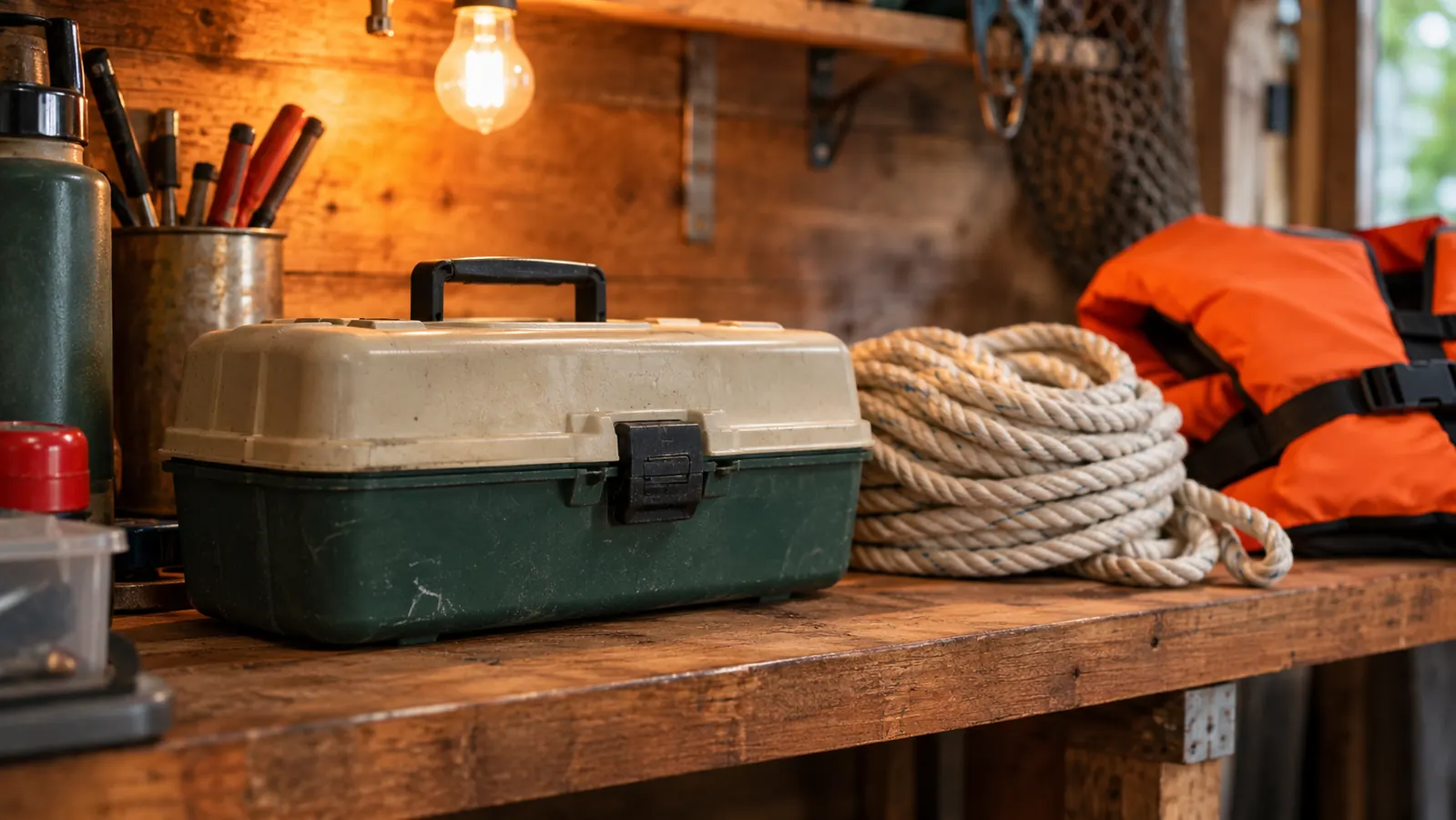
I have been caught in rain on Barkley more than once, and I have opened this box with water standing on the lid. The covers do their job. Nothing I have pulled out after a wet ride has been floating. That is not the same as a waterproof case and I would not throw it in the lake, but for the kind of rain that comes up while you are a mile from the ramp, it has been enough.
Cold is the other thing. An unheated garage in western Kentucky gets damp, and hooks live in one of those boxes year round. Two and a half winters in, I have not found rust on a hook that I could blame on the box. Some of that is luck and some of it is the covers. Either way, I have not had to change how I store it.
Where It Falls Short
Two complaints, both real. The first is weight, which I have already made. The second is footprint. At 18 inches long, 9.5 inches wide and 11 inches tall, it is a serious object in a small boat. A fourteen foot jon boat with a trolling motor on the back does not have a lot of deck, and those numbers do not shrink because the box is well built. I set it behind my seat and step around it all day. A soft bag would flatten under my foot. This will not.
It is also not the thing to carry on a road trip. When Ray and I drove to the Smokies in May, I took one StowAway box out of it and left the rest on the shelf, because there was no reason to haul the whole system across three states to fish from a public bank. The box is for the boat. It knows it. Anything that tries to be everything ends up being nothing.
What I Liked
- Three StowAway boxes included, each with a lid that stays shut
- Fifteen degree angle means you see the contents without unpacking
- DuraView covers let you check a box without opening it
- Hard shell has taken two and a half years of boat and garage use without a crack
- Utility pocket keeps a clipper and a spare spool within reach
Where It Falls Short
- Listed at 5.7 pounds before you load it, and heavy once it is full
- 18 by 9.5 by 11 inches is a real footprint on a small boat deck
- More box than you need for bank fishing or a road trip
Who This Is For
This is for somebody who fishes from a boat often enough that their tackle lives in one place and comes home with them. Somebody with more than one kind of lure, who wants jigs and crankbaits and hooks in separate containers, and who is tired of unpacking half a box to find a quarter ounce jig head. If your gear rides to the water a dozen times a season, the angled layout pays for itself in patience. It is also, frankly, a good box for somebody who has let their tackle get away from them and wants to stop.
Who Should Skip It
Skip it if you walk a long way to your water. Skip it if your boat is small enough that a hard box this size is in your way all day. Skip it if you mostly fish from a bank or on road trips, where a single StowAway box in a day pack is the whole answer. And skip it if you keep four lures and a hook sharpener, because you would be paying for three boxes and a hard shell you do not need. Check your own state's rules on licenses and limits before you go, the same as always.
If your tackle lives in the boat, this is the box that keeps it sorted
Hard sided, three StowAway boxes on a fifteen degree angle, rated 4.7 across more than 4,400 reviews. Mine has been in the jon boat since April 2024 and I have not had a reason to look at anything else.
Amazon Check Today's Price on Amazon →