
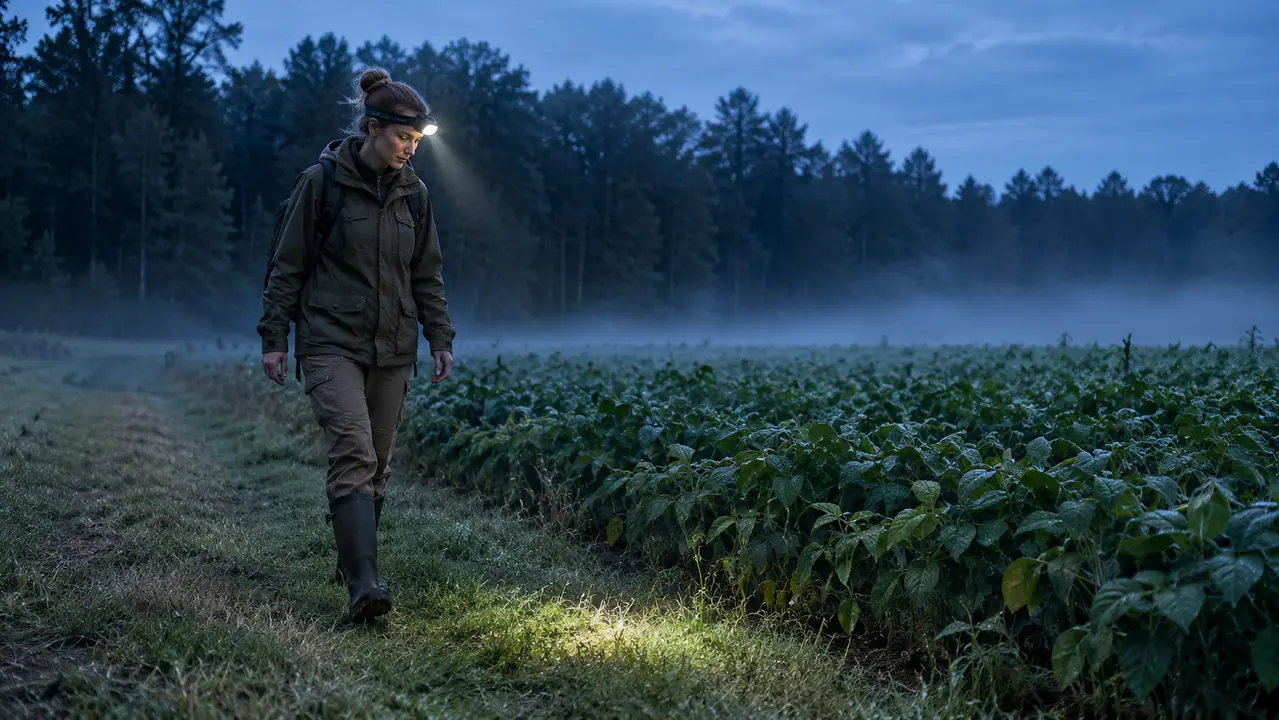
The walk from the gate to my ladder stand takes about fifteen minutes in the dark. I have made that walk with a flashlight in my teeth exactly once.
That was the fall of 2024. I bought the LHKNL rechargeable headlamp that October, mostly because it came as a two-pack and I liked the idea of a spare riding in the truck. I have owned it about two years now. One lives on the hook by the kitchen door and the other has been in the glove box since the week I bought it, and I have not had a reason to change either arrangement.
Before that I used my dad's old handheld flashlight, which is still in the kitchen drawer and still gets used for looking down Pepper's throat or hunting a dropped screw under the workbench. I am not going to tell you a headlamp replaced a good flashlight, because it did not. What it replaced was holding one in my teeth.
The Quick Verdict
Two years of dark walk-ins and pre-dawn launches and neither lamp has quit on me. It is water resistant rather than waterproof, and the three second shutoff takes a few mornings to learn.
Amazon Check Today's Price →The Lamp That Got the Flashlight Out of My Teeth
Two years on the same two lamps. One on the hook by the door, one in the truck. USB-C charging, 1,200 lumens when the ramp is dark, and a low setting you will actually walk in with.
Amazon Check Today's Price on Amazon →How I've Used It
The jobs are the same three every season and I do them in the same order.
The first is the walk in. Gate to stand is fifteen minutes through a bean field and into the hardwoods, and I want to be up the ladder and settled well before legal light. I wear the LHKNL on low white with the head tilted down so it lights the ground in front of my boots. That is the whole point of it. I am not trying to see the woods at four in the morning. I am trying not to step on a root in the dark and go down with a rifle on my shoulder.
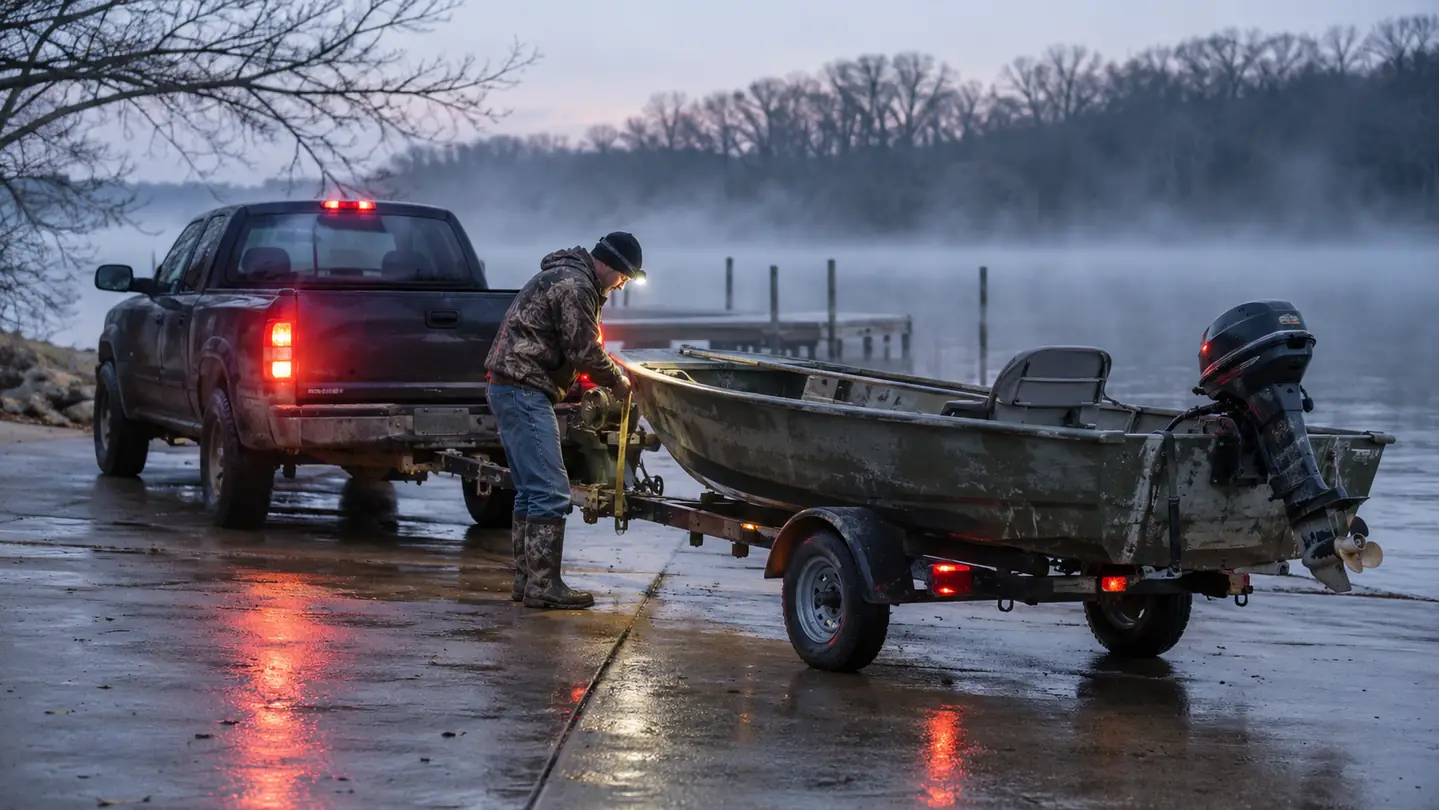
The second is the ramp. I launch a fourteen-foot jon boat at the public ramp on Lake Barkley, about twenty minutes from the house, and I am usually backing down before there is any gray in the east. Backing a trailer with a flashlight means one hand doing the work of two, and the hand holding the light is never the hand you need. With the lamp on my head, both hands are on the trailer and both eyes are on the water.
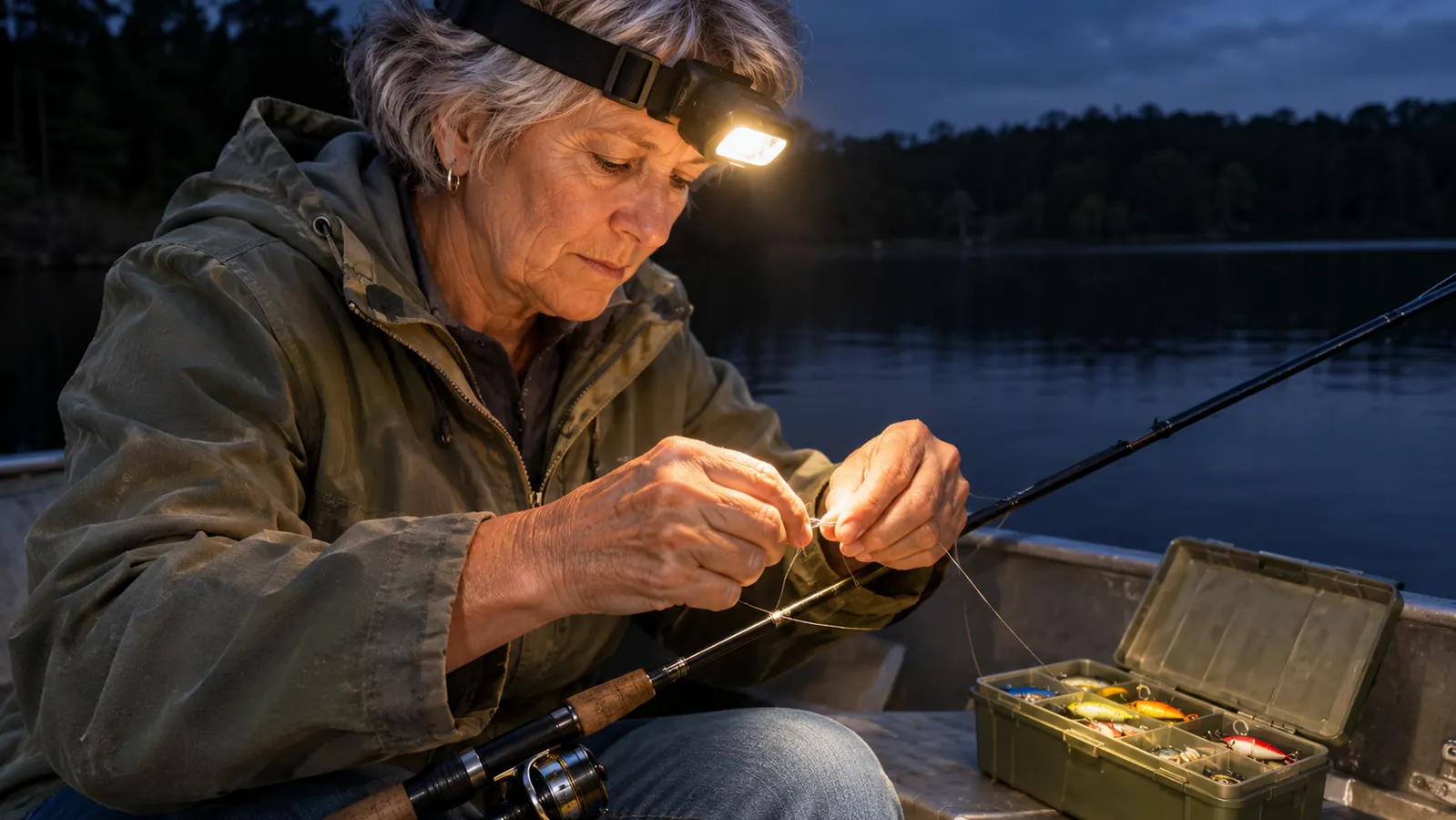
The third is knots. Tying a crappie jig on after dark with a handheld light means the light is in your teeth and the line is somewhere under your chin. I did that for years. It is a bad way to fish and it is worse when the wind is up and your fingers are stiff.
Then there is everything else it turned out to be good for, which is more than I bought it for. Changing a tire on the shoulder of the road. Looking down into the engine bay. The walk out of the woods when you want your hands free and your light pointed at the ground ahead of you. The second lamp has led a duller life in the truck glove box, used for whatever I did not plan on. Ray does not care for a headlamp, so it is not his.
Charging happens on the kitchen counter, with the USB-C cable that comes in the box. The package has two lamps, two cables, two bands and a manual I read once. I do not charge on a schedule. I charge when I think about it, which in season works out to every couple of weeks. Out of season it might sit for two months and still come on when I test it, which is more than I can say for the cordless drill.
One thing I did not expect: I use it around the house more than I ever used the flashlight. Under the sink. Up in the attic. Behind the truck seat hunting a socket I dropped. A light that lives on your head turns out to be the handiest light in the building, and the hook by the door is where the LHKNL stays.
What 1,200 Lumens Actually Does in the Timber
The listing says 1,200 lumens on the brightest setting. I have no way to check that number in my kitchen, so take it as the manufacturer's figure. What I can tell you is what it does. On high, this lamp will light the far side of my bean field. That is more light than I have ever needed at four thirty in the morning.
Where high earns its keep is the ramp, not the woods. The concrete is not lit, the trailer is not lit, and there are usually one or two other trucks waiting their turn. Seeing the whole ramp at once, the edge of the concrete, the drop off at the end, the strap on the bow, is worth something on a morning when your hands are cold and your boots are sliding on wet gravel.
For the walk in, low white is the setting. Bright light on a dark walk wrecks your eyes for the first ten minutes in the stand, and it also tells everything within a quarter mile that something is coming through the field. The low setting is what makes the lamp usable. A headlamp that only does bright is a headlamp you leave in the truck.
It weighs 1.87 ounces, which is light enough that I forget I have it on, and that is the test I use for anything I wear. The lamp head pivots about 60 degrees, so I can point it at my boots for the walk in and then straighten it up once I am in the ladder and need the light on my hands instead of my feet. The head band adjusts to fit and I have worn it over a knit cap in January without it slipping down over my eyes. Twenty years in a taxidermy shop taught me to look at seams and joints before I trust a thing. Nothing on the LHKNL has opened up or come loose in two years.
The Long Press, and the Modes I Actually Use
Every headlamp I have owned before this one had the same annoyance. Shutting it off meant clicking through the settings you did not want. The LHKNL does not work that way. Hold the mode button down for about three seconds and it goes off from wherever it is. That sounds like a small thing. It stops being a small thing the first time you are standing at the edge of a field at four forty in the morning clicking through settings in the dark.
It took me about a week to stop clicking through out of habit, and I still catch myself doing it when I am tired. That is not the lamp's fault. It is mine.
There is a red setting and I use it more than I expected to. Red does not wreck your night vision the way white does, and it does not carry as far, which matters when the stand sits off the edge of a bedding area. I walk in on red and switch to low white once I am up the ladder and getting my gear sorted. The red is for walking. That is all I use it for. I am not hunting with a light and neither should you be.
The button is small. With heavy gloves on I have hit it wrong once or twice, and hitting it wrong in the dark announces your position to the whole hollow. I have learned to find it by feel before I switch it on. That takes about two seconds and it is worth doing.
Battery, Cold Mornings, and Two Years of Charging
The battery is built in, 1,500 mAh lithium ion, 3.7 volts, and it charges by USB-C. There are no disposables to buy and nothing to throw away, which I care about more at sixty-one than I did at forty. Two years in, both LHKNL lamps still take a full charge and neither has died on me in the middle of a walk.
The listing says it will run while it is charging, and I have tested that exactly once, on a morning I forgot to top it off the night before. I plugged it into the truck on the way to the ramp and it lit the trailer when I got there. I would not make a habit of it. It is good to know it is there.
Lithium does not love cold and neither do I. On a hard freeze morning I carry the lamp in my jacket pocket on the walk to the truck instead of leaving it in the truck overnight, and I have not had one fade out on me in the stand. Two seasons of cold mornings and it has not quit once.
The spare is the part I did not expect to use as much as I do. It has been in the truck through two summers and two winters, and it comes on every time. I check it about once a month, the same day I check the jack, and that is the whole of the maintenance.
Where It Falls Short
Water resistant is not waterproof and I want to be plain about that, because a headlamp on a boat is a headlamp that will eventually get splashed. Rain and fog have not bothered mine. A dunk in the lake is a different question, I have not tested it, and I do not intend to. If your lamp is going in the water, buy one rated for it.
The high setting is more light than I need for anything I actually do. It is good at the ramp. It is useless on a walk in. That is not much of a complaint, more a note that the biggest number on the box is not the reason to buy it.
The band is comfortable and it adjusts. On a two hour sit it is fine and over a knit cap in January it is fine. It is the least interesting part of the purchase, which is how it should be.
And the two-pack means you are buying two whether you want two or not. I happen to want two. If you only wanted one, you are getting a spare anyway, which is not the worst problem to have, but it is a fact about what shows up at the door.
What I Liked
- Both hands stay free on the walk in, at the ramp and on the water
- Charges by USB-C with the cable in the box, so there is nothing extra to buy
- Hold the mode button three seconds and it shuts off from any setting
- Light enough at 1.87 ounces that you forget you have it on
- Two lamps and two bands in the pack, so one can live in the truck
Where It Falls Short
- Water resistant only, so it is not a light to dunk
- High is more light than most of my jobs need
- The button is small enough to fumble with heavy gloves on
- You are buying two whether you want two or not
I have worn this lamp on every pre-dawn launch at Barkley for two seasons, and I have not once had to hold a light in my teeth.
How It Compares to My Dad's Flashlight
My dad's flashlight is still the better light for some jobs. It throws farther, it feels like a tool in your hand, and if I need to look at something out past the fence I am not doing it with a headlamp. That is not what either one is for. The flashlight is for aiming at a thing. The headlamp is for working with both hands.
The honest weakness of any headlamp is that it lights whatever you are looking at, not whatever you want to look at. Set a flashlight on the tailgate and it stays pointed where you put it. A headlamp follows your head, which is wonderful when you are tying a knot and useless when your head is under a fender and you want light on the trailer from the side.
If you are deciding between the two, decide by the job. If the job needs both hands, you want the headlamp. If the job needs one hand and a lot of reach, you want the flashlight. I have needed both in the same morning more than once.
I keep both. The flashlight lives in the kitchen drawer where it has always lived and the LHKNL lives on the hook by the door, and I would not trade one for the other. Neither one has made the other unnecessary.
Who This Is For
This is for the person who walks in the dark and needs both hands. Hunters with a walk to a stand. Anglers who launch before light. Anybody who ties knots after sunset. Anybody who has held a light in their teeth and thought there has to be a better way than this. It suits a person who already charges a phone on the kitchen counter and does not want to think about batteries. And if you are past fifty and your close up vision has gone the way mine has, a light on your forehead is worth more than a light in your hand, because it points where you are already looking.
Who Should Skip It
If you are wading or hunting ducks and the lamp is going in the water, this is not the one. Buy something rated waterproof and pay for the rating. If you need a light that reaches across a field to identify an animal at last light, you want a handheld with a tight beam. And if you use a light four times a year, a rechargeable headlamp is a solution to a problem you do not have. My dad's flashlight got three of us through those years just fine.
If You Walk In Before Light, Start Here
Two lamps, two USB-C cables, two bands. One for the door and one for the truck. Mine have been in service about two years and neither has quit on a dark morning yet.
Amazon See the Two-Pack on Amazon →