
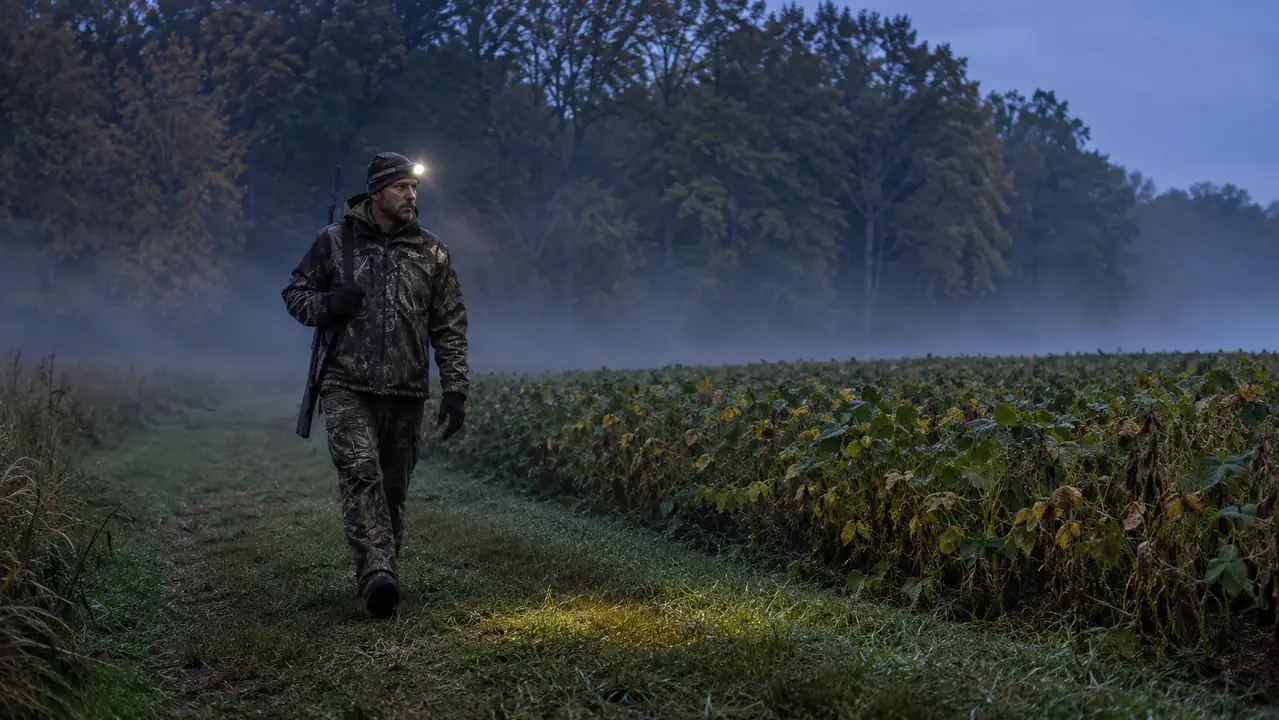
Short answer first. The LHKNL headlamp is the light I reach for when I hunt or fish. My dad's old handheld flashlight is the light I reach for when I need to put a narrow beam on one thing and hold it there. I bought the LHKNL in October 2024 after too many walks to the deer stand with one hand clamped around a flashlight and the other hand on a ladder rail. The headlamp goes on my head and stays there. The old flashlight stays in the kitchen drawer and still earns its place. If you can only own one and you go afield before daylight, buy the headlamp.
I am not a gear tester and I am not a guide. I am 61, I ran a one-woman taxidermy shop out of a converted garage for 20 years, and I have hunted and fished since my father started taking me out at 12. Close to 50 years. That shop taught me to look at how a thing is put together instead of how it is advertised, because that work did not forgive shortcuts. So this is not a laboratory comparison. It is two lights, used on the same ground, judged on the jobs that ground actually asks for.
Side by Side
| LHKNL headlamp | Dad's handheld flashlight | |
|---|---|---|
| Hands free while climbing | Band on your head, both hands on the rail and the rope | One hand stays closed around the body of the light |
| Light follows your eyes | Lamp head pivots 60 degrees, so you aim by tilting your head | You aim the whole light with your wrist |
| Both hands for a knot | Tie the knot and the light stays where you left it | You hold the light in your teeth or ask somebody |
| Battery routine | Built-in 1500mAh lithium ion, charges by USB-C, runs while charging | Takes loose cells, a fresh set goes in from a pocket in seconds |
| Reaching down a fence line | Rated 1200 lumens of white brightness, spread out for walking | A focused beam you can hold on one post at a time |
| Checking a sound without turning your face | Your head turns and the light goes with it | Point the beam where you want it and keep your chin still |
| Weight | 1.87 ounces, on an adjustable headband | Nothing on your head, a few ounces in a pocket |
| Wet weather | Listed as water resistant, with no rating number attached | No rating at all, and it has been rained on for years |
| Best for | Dark walks, the launch ramp, knots after dark | Spotting, checking, pointing at one thing |
How I Compared Them
Everything here was compared on the same 40 acres outside Cadiz and on the same water. The walk from the gate to my ladder stand takes about 15 minutes, along the edge of a small bean field and into the hardwoods, and I make it in the dark going in and again coming out. From that stand the near oak is 48 yards, the gate post is 96 yards, and the far fence is 212 yards. I know those numbers because I ranged them with a rangefinder, not because I am good at guessing. Guessing is how I missed a doe near that far fence in November 2024, and I have not done it since.
The boat is a 14-foot jon boat with a small electric trolling motor, launched at a public ramp on Lake Barkley about 20 minutes from the house. I am usually at that ramp before daylight, which means backing a trailer and then stepping over a wet tongue with my hands full. That is where a light on your head stops being a preference. It becomes the difference between a clean launch and ten minutes of fumbling in the dark while somebody else waits on the ramp behind you.
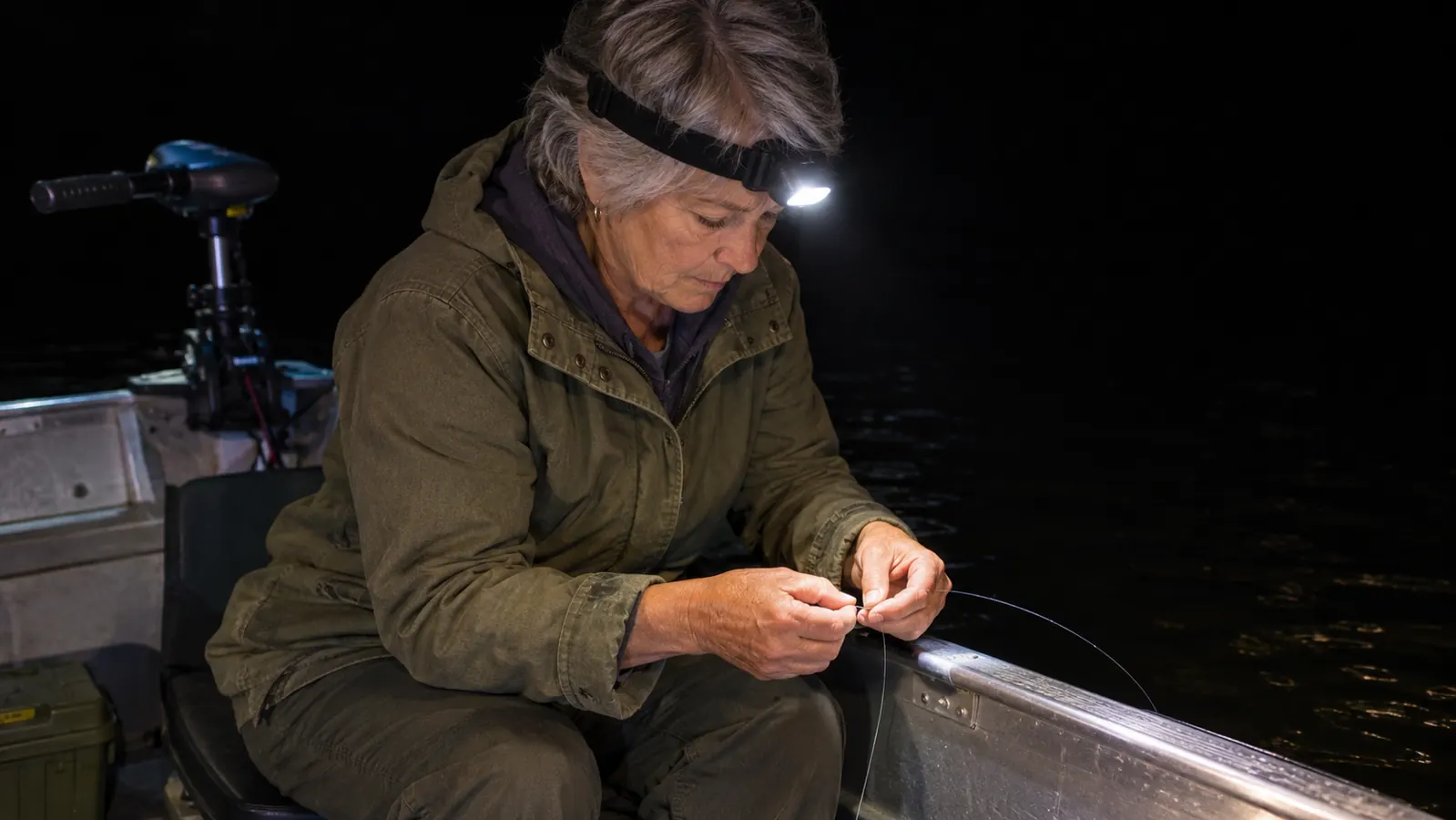
Then the small jobs nobody writes about. Tying a knot after dark with cold hands. Finding the plug in the bottom of the boat. Checking that the truck is not sitting in a puddle of something. Strapping a trail camera to a white oak down at the creek crossing. None of that needs a beam that reaches 212 yards. All of it needs light exactly where my hands already are, right now, without me stopping to think about where to point it.
Where the LHKNL Wins
Hands. That is the whole argument and everything else is detail. On the walk in I have one hand on a rifle and one on a rope or a ladder rail, and a flashlight means one of those jobs gets done badly. The LHKNL sits on my head on an adjustable headband and I forget it is there. It weighs 1.87 ounces. I have worn it for the full walk in and the full walk out and never once thought about it, which is about the highest thing I can say about a piece of gear. Gear you notice is gear that is in your way.
The lamp head pivots 60 degrees, and that one feature does more for me than the brightness number does. Tying a knot on the gunwale, I tilt my head down and the light falls on my hands instead of on the water 20 feet past them. Wanting to see the path ahead, I look up. I am not aiming a light, I am just looking at things, and the light agrees with me. After two years of that, picking up a handheld and aiming it feels like choosing to do the job one-handed on purpose.
The controls are plain. There is a key mode button, and holding it for about three seconds turns the lamp off from whatever mode it is in, so you are not cycling through everything to get to dark. In the cold, with gloves on, that matters more than it sounds. It charges by USB-C on the kitchen counter, the cable comes in the box, and it will run while it is charging, which means a dead lamp at the truck is a ten minute problem and not a wasted morning. Mine came as one of a two-pack. The second one has lived in the truck since the day I bought them, and it is the spare I have never needed.
Where My Dad's Flashlight Wins
Cells. The old flashlight takes loose batteries, and when it goes dim I put a fresh set in from a pocket in about ten seconds. The LHKNL has a 1500mAh lithium ion battery built into it, and when that one is empty it wants a cable and a wait. I have not been caught out, because charging it on the counter is a habit now, but I know the shape of that failure and I am not going to pretend I do not. A light with the battery sealed inside is only as good as your last good intention.
Reach. A handheld lets me put a narrow beam on one thing at a time. Down the fence line, across the field, at the far edge of the gravel where the truck is parked. A focused beam I can hold steady tells me more about a shape at 60 yards than a wide wash of light on my forehead ever will. The LHKNL is rated 1200 lumens of white brightness, and that is bright enough to walk by and more than bright enough to work by, but it is built to light what is around me. It is not built to interrogate something a long way off.
And the odd one. A handheld lets you look at something without turning your face toward it. If I hear a noise at the edge of the field and I do not especially want to be looking straight at it, I can point a flashlight off to the side and keep my chin where it was. With a headlamp, wherever I look is where the light goes, and if I want to see it, I have to face it. In close to 50 years that has never caused me a real problem, but I have noticed it, and I would rather say so than pretend the headlamp has no limits.
The light that is already pointed at what you are looking at
Two headlamps, two USB-C cables and two adjustable headbands in the box. One has been on my head for two seasons of dark walks, ramp launches and knots on the water. The other still lives in the truck as the spare.
Amazon Check Today's Price on Amazon →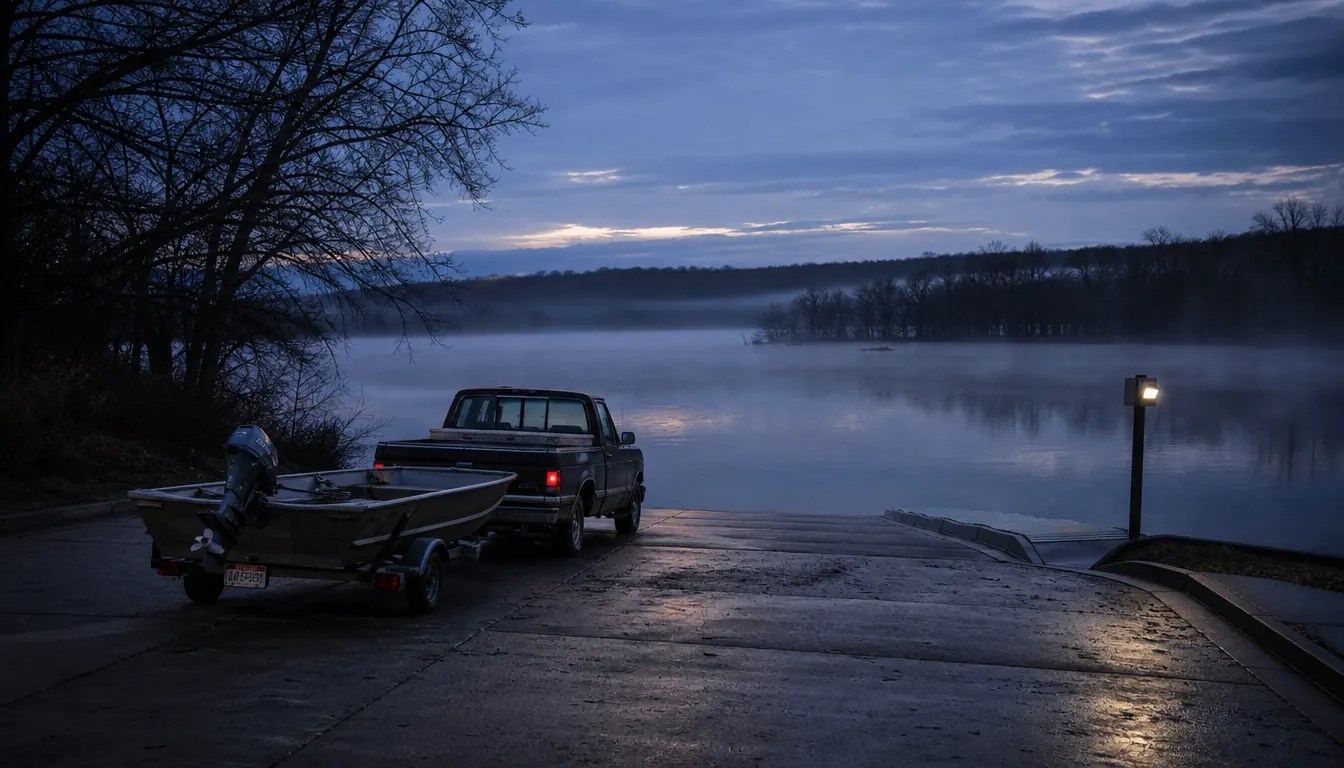
Three Jobs Where the Headlamp Is the Wrong Tool
Signaling. If I ever needed to wave somebody down from the edge of a field, a light I can swing in my hand is the one to swing. A headlamp points where I look, and where I look is not always where I want to be seen from. That is a small thing and it will probably never matter to me. It is still true.
Handing light to somebody else. When Ray rides along and I am setting up the boat in the dark, he wants light on the trailer while I am doing something else. Taking the headlamp off and handing it over means handing over my light for as long as he has it. Passing a flashlight costs nothing and nobody has to stop what they are doing.
Anything under the truck. Lying on my back under a rear end, the headlamp is exactly right until a frame rail gets between me and what I need to see. Then I want a light I can poke up into a gap and angle by hand. I have done it with the headlamp anyway and I have also gone back inside for the old light, so draw your own conclusion. The headlamp is better at the jobs you do standing up.
What the Listing Says and What Two Years Says Back
The listing calls it water resistant and does not attach a number to that, which is honest enough as far as it goes. I have worn it in cold rain and in fog on the walk in without a problem, and I have set it down on wet ground at the ramp. I would not drop it in the lake and expect a good outcome, and I do not. The headband has stretched a little with use, the way elastic does, and it still tightens down enough to stay put over a knit cap in November.
The pivot is still firm. Nothing has gone loose or started to rattle. The band has held. The one thing I notice now that I did not notice in the first month is that the brightest setting is more than most of my jobs need, so I run it lower and get more evenings out of a charge. That is not a complaint about the light. It is a complaint about my own habits, and I am working on it.
My dad's flashlight is older than most of the trucks in that ramp parking lot, and it still comes on when I press it. I think he would have liked the headlamp, said so once, and gone back to his own. That is about the highest praise available in my family.
I have worn it for the full walk in and the full walk out and never once thought about it. Gear you notice is gear that is in your way.
Who Should Buy Which
Buy the LHKNL if you go afield before daylight or come out after dark, and especially if you do it alone. The walk to a stand, the launch ramp, a knot at the transom, the cleanup at the truck. Any job where both hands are busy and the light needs to be somewhere specific. I use the red setting and the low white one for walking, since both leave me enough night vision to see past the beam, and I save the brighter settings for the ramp and for knots.
Keep a handheld if you already have one. It is better at pointing at something far off, better at looking at a thing without moving your face, and loose cells mean it works when nothing in the house has been charged. Mine stays in the kitchen drawer for the meter, the crawlspace and the driveway. I would not carry it to the stand again, and I doubt I will.
If you fish after dark from a boat, the headlamp is the one, and it is not close. If you mostly walk fields and glass the edges from the truck, a handheld in the cupholder does that job fine and you have already paid for it. Buy the tool for the job you actually do on a Tuesday morning in November, not the job you read about on a forum.
Buy it for the walk in, not for the catalog photo
If your dark hours are spent with both hands full, this is the fix I would start with. Charge it on the kitchen counter, put it on your head, and stop carrying a light in your teeth. Check your own state's rules on legal hours and lights before you go.
Amazon Check Today's Price on Amazon →