
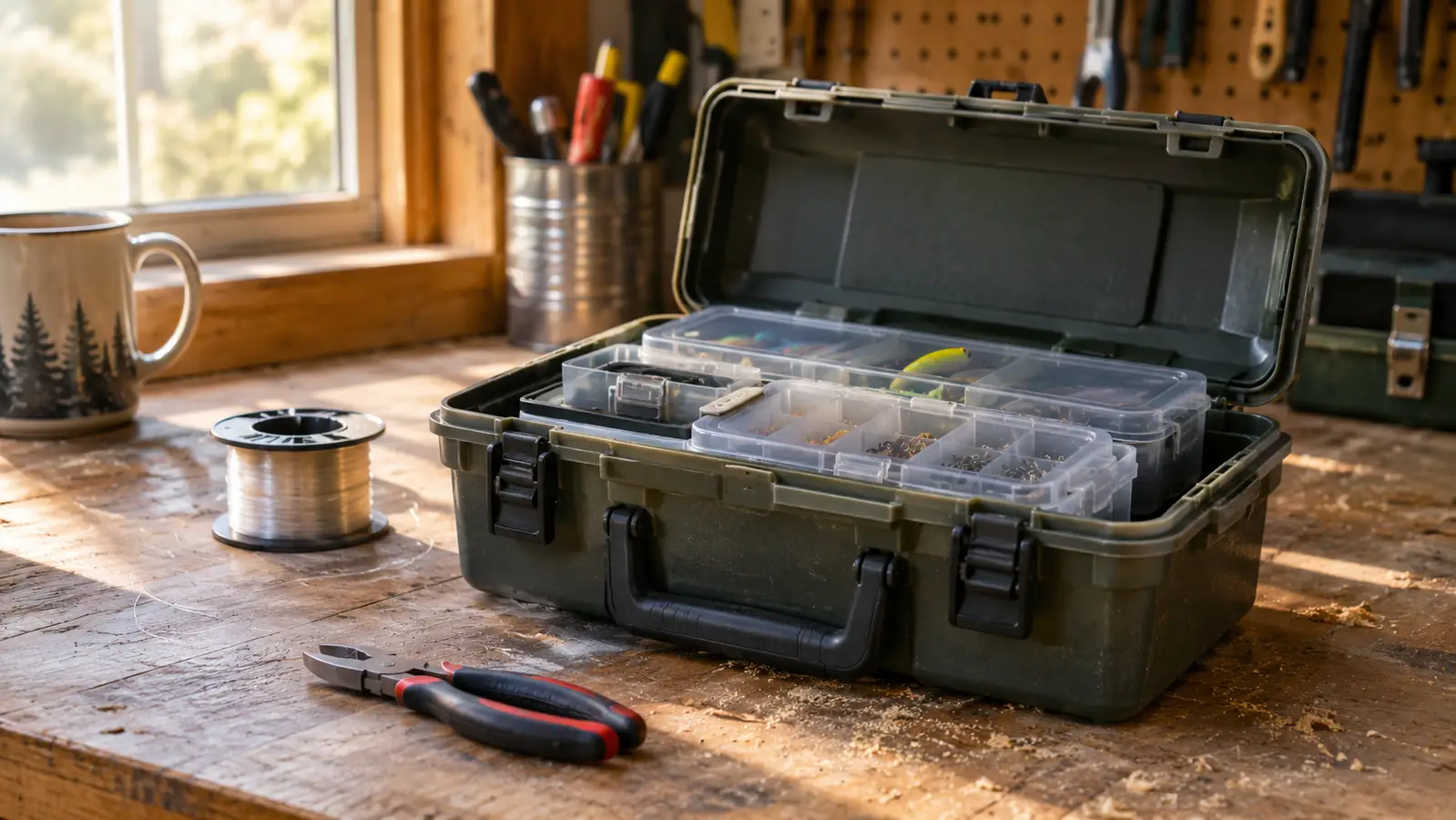
My dad's tackle box was one metal tray that folded out like a staircase, and for about thirty years it held everything I owned. Every lure, every hook, every spare swivel, all in one place. It worked because I had almost nothing in it. Then I started fishing Lake Barkley regular, and my tackle grew past what a folding tray could hold, and I did what most people do. I started dropping loose bags and loose boxes into a canvas tote and telling myself I knew where everything was.
I did not know where everything was. I knew where everything had been the last time I looked. That is a different thing. In April 2024 I bought the Plano Angled Tackle System with three StowAway boxes, and it took one weekend to sort out what three decades of drift had turned into a mess. Here is the method I used, step by step, and then the parts of it that still give me grief.
One weekend, three boxes, and you stop digging for a jig
The Plano Angled Tackle System holds three StowAway boxes at a 15 degree tilt so you can see the contents without unpacking anything. 4.7 stars from 4,421 buyers.
Amazon Check today's price on Amazon →Step 1: Dump everything out and look at it
Not a metaphor. Get a sheet or a big piece of cardboard, spread it on the garage floor, and turn the whole mess out onto it. Every box, every loose bag, every hook that has been rolling around in a bottom compartment since the Clinton administration. This is the part people skip because it looks like nothing is happening, and it is the only part where you learn what you actually own.
What I learned was that I had four kinds of the same crappie jig, in four colors, in four different bags. I had a sandwich bag of split shot that had split open and distributed itself through everything else. I had three packs of hooks still in their cardboard, and about forty hooks that were not. Nobody needs both.
Spread it all, then start making piles. Not organized piles yet. Rough piles. Things that go on a jighead, things that are soft plastic, things that are hooks and weights and snaps. If you are not sure where something goes, put it in a fifth pile and come back to it. My fifth pile had a broken crankbait in it, a piece of line I could not identify, and a rusty hook that I threw off the porch into the yard. That pile was the most useful one.
Step 2: Sort by how you fish, not by what the bait is called
This is where most tackle organization fails. People sort by the catalog. All the crankbaits in one place, all the plastics in another, all the jigs in a third. That sounds tidy, and then you get to the water and you are fishing a brush pile in twelve feet of water and everything you need is in three different boxes.
Sort by the trip instead. I fish two ways on Barkley. I fish crappie jigs around brush and standing timber, and I fish soft plastics and crankbaits for bass along the bank. Those are two different jobs and they want two different boxes. The third box is not a fishing method at all. It is terminal tackle, the hooks and weights and snaps and swivels that every trip needs no matter what you are chasing.
So the three StowAway boxes in my Plano run like this. Box one is crappie jigs and the jigheads they go on. Box two is bass soft plastics and crankbaits. Box three is hooks, weights and terminal tackle. That is it. That is the whole system. It has not changed in two and a half years except when I add something new, and when I add something new I know exactly which box it goes in without thinking about it.
Getting organized is not the hard part. The hard part is having one obvious home for a thing so that putting it away correctly takes less effort than dropping it loose.
Step 3: Give each StowAway box one job and label it on the lid
The Plano arrives with three 3560 StowAway boxes and each one has a clear DuraView lid, so in theory you can see what is in it without opening anything. In practice you can see that there is a mass of small objects in there and not much more, especially once the box is sitting at an angle in the main compartment and the light is behind you.
Label them. A strip of masking tape and a Sharpie on the lid. Crappie. Bass. Terminal. That took me four minutes and it has saved me from opening the wrong box several thousand times. If masking tape is too plain for you, use a paint pen directly on the lid, but do not skip it. The clear lid helps from about a foot away in good light. A label helps from across the garage.
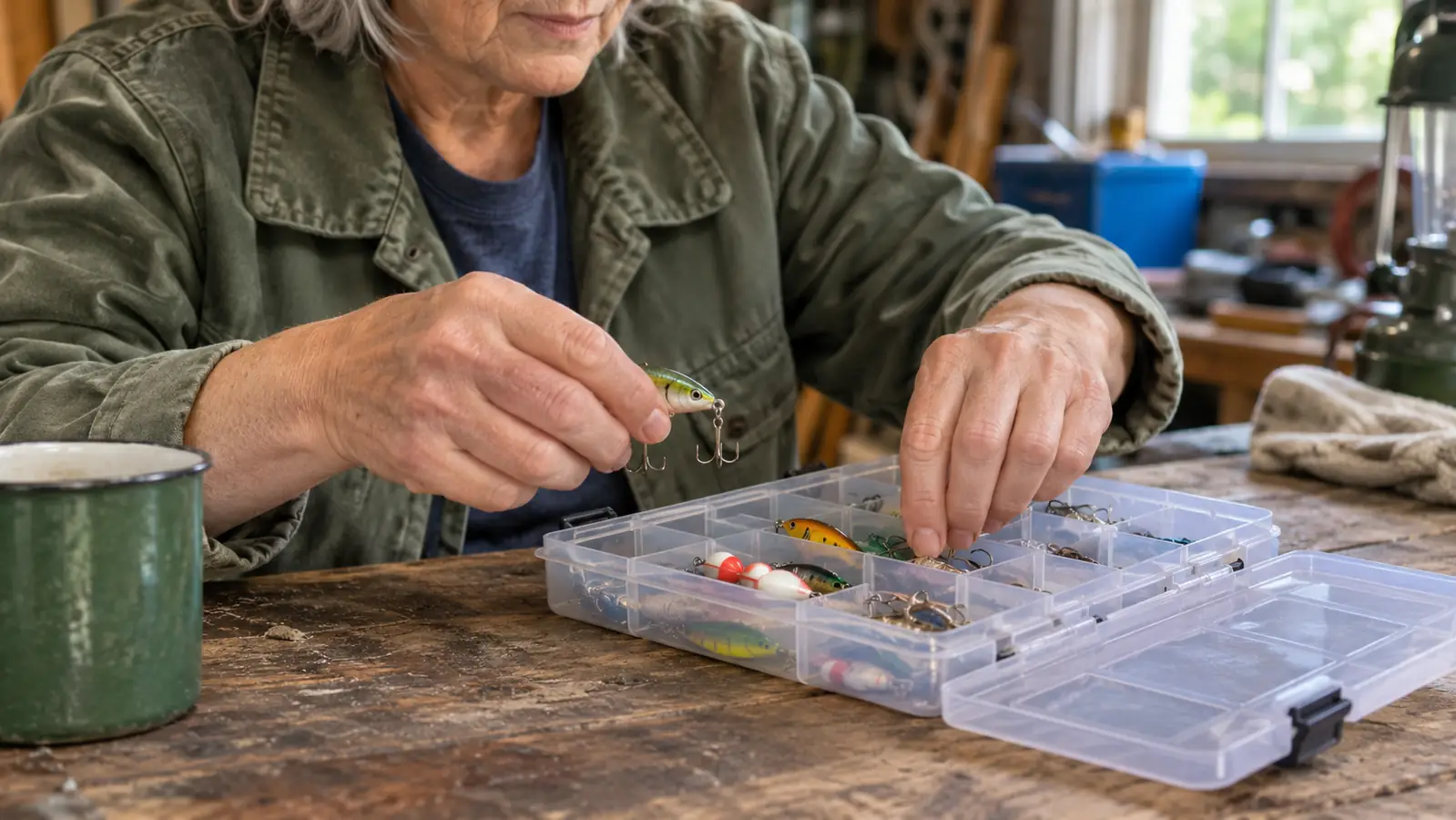
While you are at it, look at how the compartments inside each StowAway are laid out before you commit. Some have long dividers, some have a grid of small squares. Put the long stuff in the long dividers. That sounds stupid written down and I still had to move a pack of six-inch worms twice before I got it.
Step 4: Put the terminal tackle in the box that leaves the garage most often
This step will not make sense until you have fished out of a small boat for a while. Terminal tackle is the gear you need on every trip regardless of species or season. Hooks, split shot, snaps, swivels. If your terminal tackle lives in the big box that stays on the shelf, then every trip you either carry the big box or you go without.
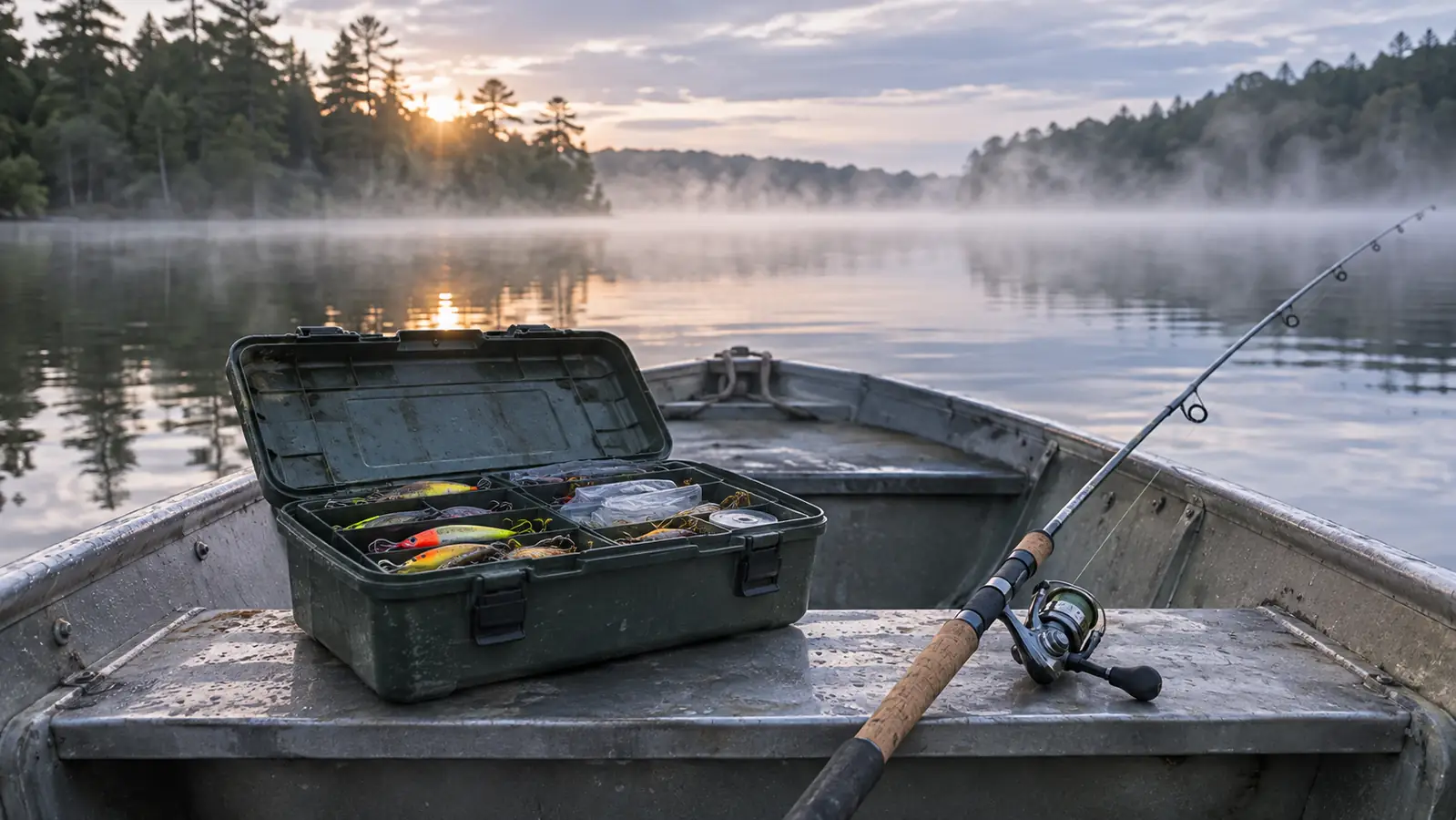
In my Plano, box three, the terminal box, is the one that gets pulled out and set beside me in the jon boat. The other two stay nested in the angled compartment. When I take a road trip, box three is the only one that goes. It was the box that went to the Smoky Mountains and to the Ozarks, and both times it was enough for bank fishing for trout and small bass on a public shore.
One honest note about the angled design. The main compartment presents the boxes at a 15 degree angle, which does make them easier to read and easier to grab. It also means a box that is not clicked shut all the way can spill forward when you open the lid. I have done this once. It was split shot. I am still finding split shot in that boat.
Step 5: Do a five minute reset at the end of every trip, not a spring cleaning
The reason tackle gets away from you is not that you never organize it. It is that you organize it thoroughly once a year and then live in the wreckage for eleven months. The fix is small and frequent. When you get home and the boat is still hooked to the truck and you want a sandwich, take five minutes and put the loose stuff back where it came from.
Five minutes. That is the whole commitment. Open the box you used, put the jig back in the crappie box, put the hook back in the terminal box, click the lid. If something is wet, leave it out on the bench to dry before it goes back in, because a wet lure in a closed box will rust a hook and the rust will move to everything it touches.
Once a season, pull all three boxes out and check the terminal box specifically. Hooks rust. Snaps fatigue. A snap that has sat in a damp box too long will let you down, so I dump the terminal box on the bench every spring and throw away anything that looks tired. It takes fifteen minutes and it has been worth it every year.
What Else Helps
The Plano handles the tackle itself, and that is the hard part, but it is not the whole job. Two other things made a difference. The first is a headlamp. I launch the boat before daylight and I tie knots after dark, and a handheld flashlight means one hand doing the work and the other hand holding the light. My dad's old flashlight still lives in the kitchen drawer and I still use it for a lot of things, but not for knots. A headlamp on low white is the right tool and it is a small thing to fix.
The second is a firm rule about the boat. One box comes out at a time. Not two, not all three spread across the seat. One box open, the other two clicked shut and nested. I learned this the ordinary way, by opening two at once on a breezy morning and watching a page of soft plastics go over the side. They floated, which was the only good news of that hour, and I gathered them up with the net while saying things a retired taxidermist should not say.
On the soft plastic side, keep the bags. The Plano does not come with dividers fine enough to hold loose soft plastics in any useful way, and the original bags are already labeled with size and color. Box two in my system holds bags, not loose baits. That is not a compromise. That is the way it should be. The dividers are for hard baits and jigheads, where a compartment per item makes sense.
One more thing, and this is a matter of taste. I keep a small rag in the bottom of the Plano. It does nothing for organization. It is there because my hands are usually wet and I got tired of a wet hand going into a dry box.
Who This Is For
This system suits somebody who fishes two or three different ways and has accumulated enough tackle that the old single-tray box stopped working. If you are carrying a folding tray and it is full, you are already past the point where this helps. It also suits boat fishermen, because the angled compartment is genuinely easier to work out of on a seat than a flat box, and the hard shell takes a knock without cracking.
It suits somebody who wants one box that does the job and does not want to think about tackle storage again. I have not bought another tackle storage item since April 2024 and I do not expect to. The Plano is 18 inches long, 9.5 wide, 11 tall, and 5.7 pounds empty, which is a size that fits behind a boat seat and on a garage shelf without a dedicated spot. That is the whole appeal. It is a hard box that does one job and does it plainly.
Who Should Skip It
If you fish out of a kayak or you walk in to your spots, skip it. This is a hard-sided box that wants to sit somewhere, not a bag you sling over a shoulder. I have carried it from the truck to the ramp and that is fine. I would not carry it a half mile.
If you are a trout fisherman with two small fly boxes and a net, skip it. You do not have the problem this solves, and the compartments are sized for conventional tackle, not flies. And if you want everything visible at a glance with nothing nested, this is not that either. The boxes sit inside a compartment, which means one box is always partly behind another. That is the trade you make for a system that holds three boxes in a footprint that fits behind a seat.
The last thing I would say is the thing I would say about most gear. This is a box. It organizes what you put in it, and it will not organize anything you drop loose into the boat. The sorting has to happen once, honestly, on a sheet on the garage floor with everything spread out in front of you. After that the box makes it easy to stay sorted. It cannot do the first part for you.
Sort it once on a garage floor, then never think about it again
Three 3560 StowAway boxes nested at a 15 degree angle, a clear DuraView lid on each, and a hard shell that rides behind a boat seat. 4.7 stars from 4,421 buyers.
Amazon Check today's price on Amazon →