
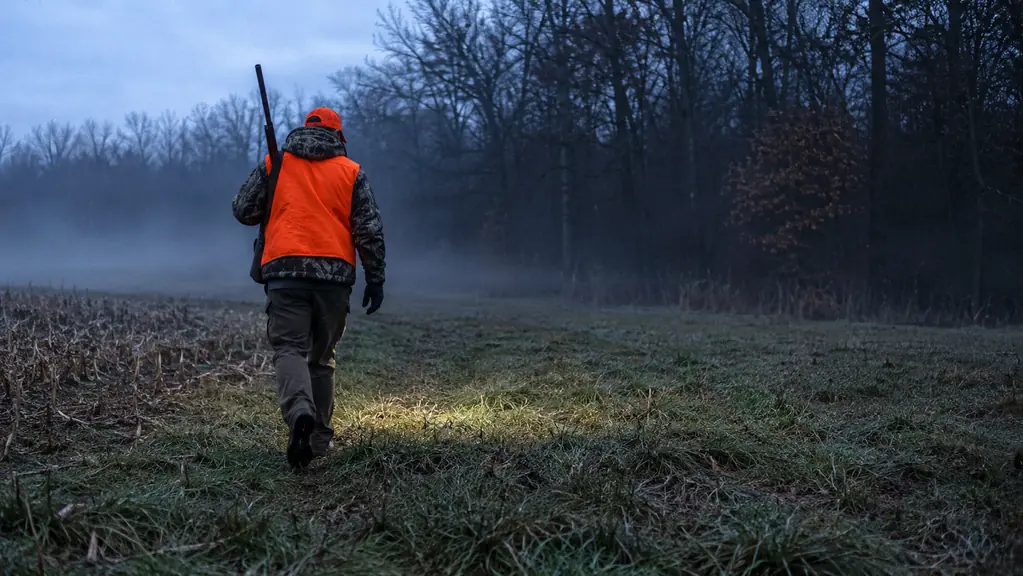
There is a fifteen minute walk between the gate where I park my truck and the one ladder stand I hunt from, on a big oak at the edge of the bean field. In November I make that walk in the dark. I have made it in the dark for close to 50 years, and for the last two of those years I have made it with a light strapped to my head instead of one swinging down by my knee.
Brightness was never the problem. My dad's old flashlight will put a hole in the dark. The problem is that a light in your hand moves when you move. It swings with every step, it throws a shadow every time it swings, and at five in the morning a shadow in the brush looks like a deer, a stray dog, or a man standing where no man ought to be.
I bought the LHKNL headlamp in October 2024. It comes as a two-pack, so one lives in the house and the other stays in the truck as a spare, and I have not carried the flashlight to the stand since. What follows is how I actually use it on that walk: fitting it, aiming it, what I point it at and what I do not, and where a light like this stops helping and a person has to lean on something else.
I am not a guide and I do not test gear for a living. I ran a one-woman taxidermy shop out of a converted garage for 20 years and closed it in 2023, which means I spent two decades looking closely at how things are put together. That is the only credential I have. It does make me hard to impress with a plastic housing.
Before the headlamp I tried the other ways. I tried holding the flashlight under my arm, which lights the ground about four feet ahead and blinds you on the bounce. I tried clamping it to the bill of a cap, which works until you turn your head to spit and the beam goes sideways into the trees. A strap on the head sounds like a small improvement. It is not small. It is the whole thing.
One light, both hands free, and a beam that points where you point your face
This is the two-pack I bought in October 2024 and have walked to the stand with ever since. One for the house, one for the truck. USB-C charging, 1.87 ounces, and a lamp head that pivots so the beam lands on the ground instead of the treeline.
Amazon Check Today's Price on Amazon →The Walk, Step by Step
Five things separate a quiet walk in from a walk that educates every deer inside two hundred yards. Four of them are free. The fifth is the light, and it only helps if you use it like a tool and not like a lantern.
Step 1: Fit the light before you leave the truck
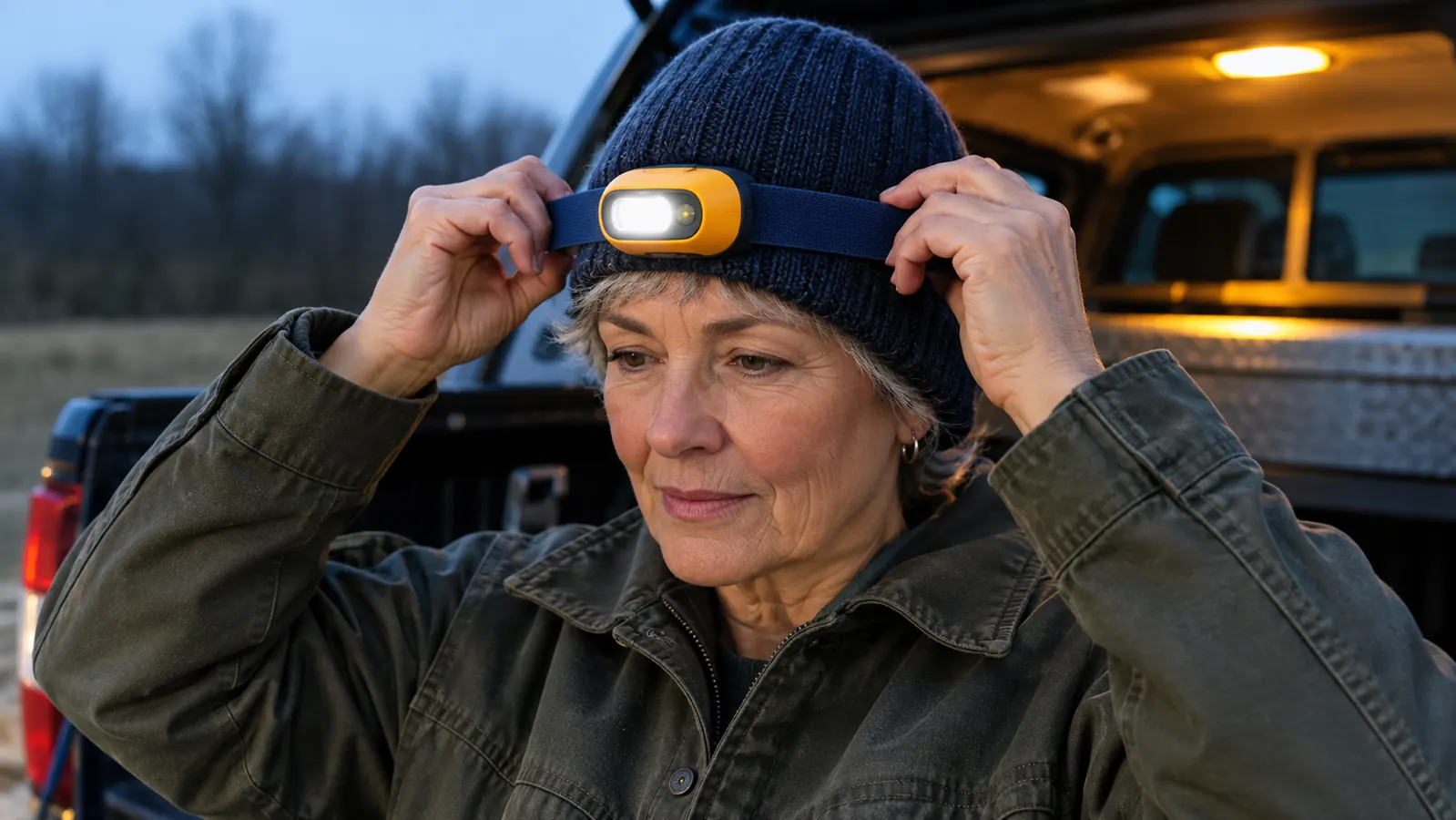
The worst place to adjust a headband is in the woods with gloves on. I put the lamp on my head in the truck cab, before I ever open the door, and I get the band right then. The whole unit weighs 1.87 ounces, so it does not take much tension to hold it in place, and too much tension is exactly what gives you a headache by the time you reach the stand.
The lamp head pivots 60 degrees. That matters more than people think. I set it angled down maybe a third of the way before I start, so the beam falls on the ground six or eight feet in front of me instead of straight out into the trees. If I need to look up, I push it up with one finger. If I leave it flat, I am painting the whole field edge with every step I take.
One more habit from the cab: I do the fitting with the light off. Then I switch it on, check the angle against the dashboard, and switch it off again. Otherwise I blast the windshield, lose my night vision, and start the walk half blind before I have taken ten steps.
Step 2: Keep the beam on the ground
The lamp has adjustable modes and 1200 lumens available, and I almost never touch the top of that range. I use the dimmest setting that still shows me my feet. A hard beam bouncing back off fog or wet leaves does not show me more ground, it shows me less, because my pupils close down and everything past the hotspot goes black.
There is also the matter of other people. On public ground during gun season, a light swinging through the timber at half past five is a signal, and not always a welcome one. A low beam pointed at your own boots says person walking to a stand. A high beam sweeping the treeline says something else entirely. I have had a stranger answer me from a ridge I did not know anyone was on, and I did not care for it.
And the deer. I am not naive about this. A light does not make you invisible. But a steady, low, downward beam moving at the pace of a walking person is a lot less interesting to a deer than a beam that stops, sweeps, and stops again. The animal reads movement and pattern. Give it nothing to read.
The LHKNL also has the one habit that saves me here. Hold the mode button for three seconds and it shuts off from whatever setting it is on, instead of making you cycle through every mode to get to off. On a cold morning with gloves on, that is not a small convenience. That is the difference between a dark woods and a light show.
Step 3: Walk the route once in daylight
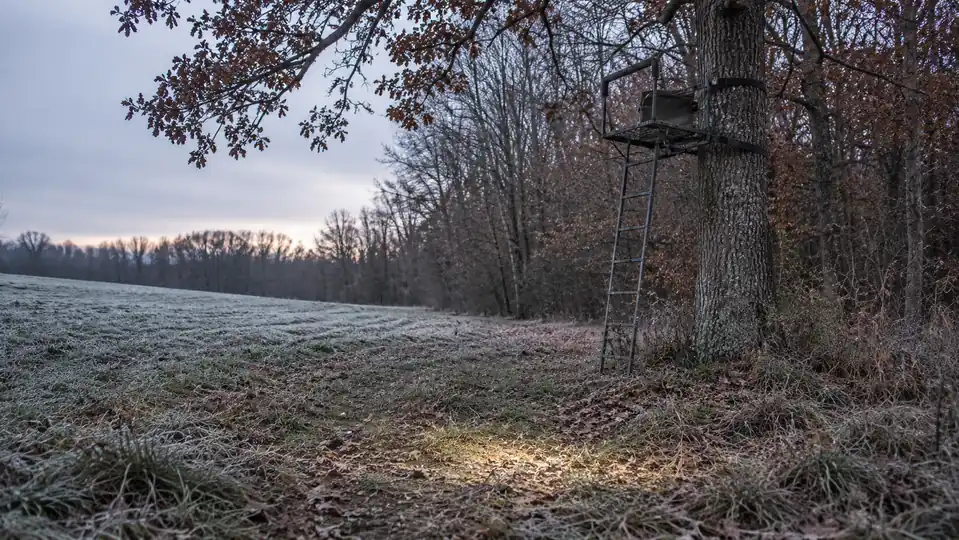
No headlamp replaces knowing where you are going. Before the season I walk the route from the gate to the stand in the middle of the day, and I pick out three or four marks I can find in the dark: the gate post, the low place where the ground stays wet, the near oak, and the big oak the stand is bolted to.
I have ranged those marks from the stand with the rangefinder, mostly so I know what I am looking at when I settle in. The near oak is 48 yards. The gate post is 96. The far fence is 212, which is past my own limit of 150 and past where I would take a shot at all. Those numbers are worth having in your head before daylight, not after.
In the dark the marks are not numbers. They are shapes and sounds. The wet place squelches. The near oak is a blacker black against the sky. The gate post is a straight edge where everything else is soft. A person who has walked the route in daylight is following a path. A person who has not is following a light, and a light does not know where the stand is.
Fog is what tells you whether you did the homework. On a real foggy morning the beam comes back at you at about ten feet and the marks are all you have. I have walked in on nothing but the squelch of that wet spot and the shape of the near oak, and I have been glad of it.
Two seasons, a charge every few trips, and I have never once had to take that light off my head to see where I was putting my foot.
Step 4: Slow down and give the light one job
The beam is for footing. That is the job. It is not for glassing the field, it is not for finding the trail marker you think you remember from last year, and it is not for deciding whether the shape at the edge of the beans is a deer. On a fifteen minute walk I want to arrive with dry boots and quiet feet, and nothing else.
Slow is the whole technique. Wet leaves over hardpan are loud, and a person moving fast makes a rhythm that carries further than a person moving slow. I go about half the pace I would in daylight, heel first, with the light on the ground two steps ahead so I can see the root before I trip over it. With both hands free I can carry the cushion and the rifle properly instead of juggling them.
The creek bottom is the part that matters. It is mud and rock and it holds water for days after a rain, and I have gone down on my backside in it in the dark, back before I had a headlamp. Nothing about that is dangerous. It is just loud, and it is cold, and it costs you the first hour of the sit while you sit there wet and annoyed.
Step 5: Go dark for the last thirty yards
Twenty or thirty yards short of the stand, I switch the light off and stand still. It takes a couple of minutes for my eyes to come back to me. Then I climb, hook the harness to the tree, sit down and wait. Legal shooting hours start when they start, and I want to be settled well before then, not arriving on the ladder at the minute.
The headlamp stays on my head, switched off. If I drop a glove or a shell I would rather press a button than climb down and hunt for it with my hands in the leaf litter. I do check that the button is where I left it, because a light coming on by itself in a dark stand is the one thing this whole system makes easy to do wrong.
The walk back out is the other half of the same job. A morning sit ends and the woods are still dim, and that same low beam gets me to the gate without a flashlight clamped in my teeth. It is also what I use at the ramp before daylight and what I use to tie a knot after dark on the water, which is not why I bought it and is what it does most of the year.
What Else Helps
Charging is a kitchen counter job in my house. The LHKNL charges by USB-C, and the two-pack comes with two cables and two headbands, so one cable stays in the kitchen drawer and one stays in the truck. I top it up every few trips rather than running it flat, and I have not had it quit on a walk yet. I do not wait for the battery to die before I plug it in, because the one morning it does die is the morning you needed it.
It is water resistant, not waterproof. Fog, drizzle and a wet hand are fine. I would not leave it sitting out in a downpour or drop it in the creek and expect a good outcome, and I do not. The band is adjustable and the whole thing is light enough that I forget it is on until I take my hat off at the truck.
Cold is the thing I watch. A battery in November in Kentucky is not the same battery it was in October, and a light that ran all evening in the garage can look tired at dawn in the stand. I charge before a cold snap rather than during one, and I keep the spare in the glove box where it stays out of the weather.
The rest of the kit does its own jobs. The rangefinder rides in my jacket chest pocket for the three marks. The trail camera stays on the white oak at the creek crossing, watching the crossing and nothing else. The old spinning rod lives in the boat. The headlamp is the one piece that touches every trip, because every trip starts and ends in the dark.
The light I reach for at 5 a.m. and again at the ramp
Two seasons of dark walks, pre-dawn boat launches and knots tied after sunset. If your hands are full and your flashlight is in your teeth, this is the fix I landed on. Check your own state's rules on lights and hunting hours before you go.
Amazon See the LHKNL Headlamp on Amazon →