
Nothing about a tackle box is interesting until it lets you down. That is the plain truth of it. I have had the Plano Angled Tackle System with its three StowAway boxes riding in the boat since April 2024, close to two and a half years now, and the reason I am writing this instead of just going fishing is that most write-ups of it stop at the lid angle and never get to the parts that decide whether you keep the thing or leave it on a shelf.
So here is who I am, so you can weigh this accordingly. I am 61, retired, and I live outside Cadiz, Kentucky on 40 acres of family ground. My father had me out hunting and fishing from the time I was 12, so that is close to 50 years of handling gear, most of it cheap gear handled a long time. I fish for crappie and bass out of a 14-foot jon boat with a small trolling motor, launched at the public ramp on Lake Barkley about 20 minutes from my house. Before the Plano I owned exactly one tackle box, a metal one that belonged to my dad, and it sits on a garage shelf now because I cannot bring myself to part with it. Nobody sent me this box. Nobody paid me for this. That is the whole arrangement.
The Quick Verdict
It organized my tackle in a single Saturday and has held that order for two and a half years. It is a hard shell that is not sealed against rain, tall enough to matter, and capped at three boxes.
Amazon Check Today's Price →Two and a half years in the boat and I would buy it again
Three StowAway boxes, a hard shell, and a main compartment that tilts the boxes up at 15 degrees so you can see what you are reaching for. It is the box that finally got my crappie jigs out of a coffee can.
Amazon Check today's price on Amazon →How I Have Actually Used It
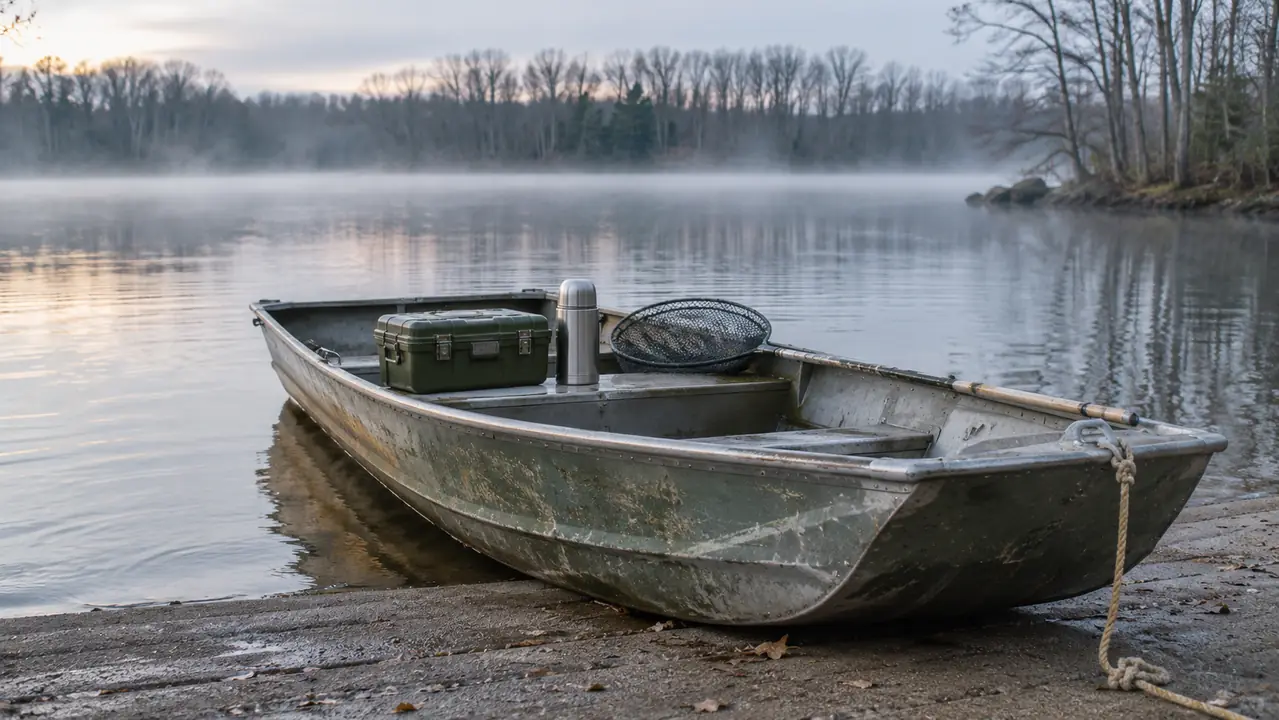
The box has gone on every trip since the day I brought it home. Not a rotation, not a rotation of two. Every launch at that public ramp, in April cold and July heat, in fog thick enough that I idled out past the no-wake buoy before I could see the far bank, and once in a rain that came up faster than the forecast had any right to. When I am not on the water the box sits loaded on a shelf in the garage, and it goes back into the truck the night before I plan to fish.
The first weekend I owned it I did the chore I had been putting off for years. I dumped the old metal box out on the workbench and sorted the whole mess into the three StowAway boxes: crappie jigs in one, bass soft plastics and crankbaits in another, hooks and weights and terminal tackle in the third. That took most of a Saturday afternoon. I have not re-sorted it since. Not once. In the metal box, finding a single 1/16 ounce jig head meant lifting out three trays and setting them down on the boat bench, where the wind could take them and where I would eventually step on them.
To give you an idea what was in that metal box, I counted as I went. Nineteen loose jig heads rolling in the bottom, four of them the 1/16 ounce size I use most, seven crankbaits still in their cardboard, and a clump of hooks rusted together that I threw out. The rust is what convinced me. A box that lets water sit in the bottom will do that to hooks, and my dad's box had been doing it for years without either of us mentioning it.
I am not a guide and I do not fish tournaments. I get out maybe twice a month from spring through fall and less than that in the winter, when the crappie are deep and I am less inclined to go find them. Two and a half years at a hobbyist's pace is not a pro's pace, and I am not going to pretend otherwise. But it is enough mornings that I know exactly what this box does and exactly what it does not.
What the 15 Degree Angle Really Does
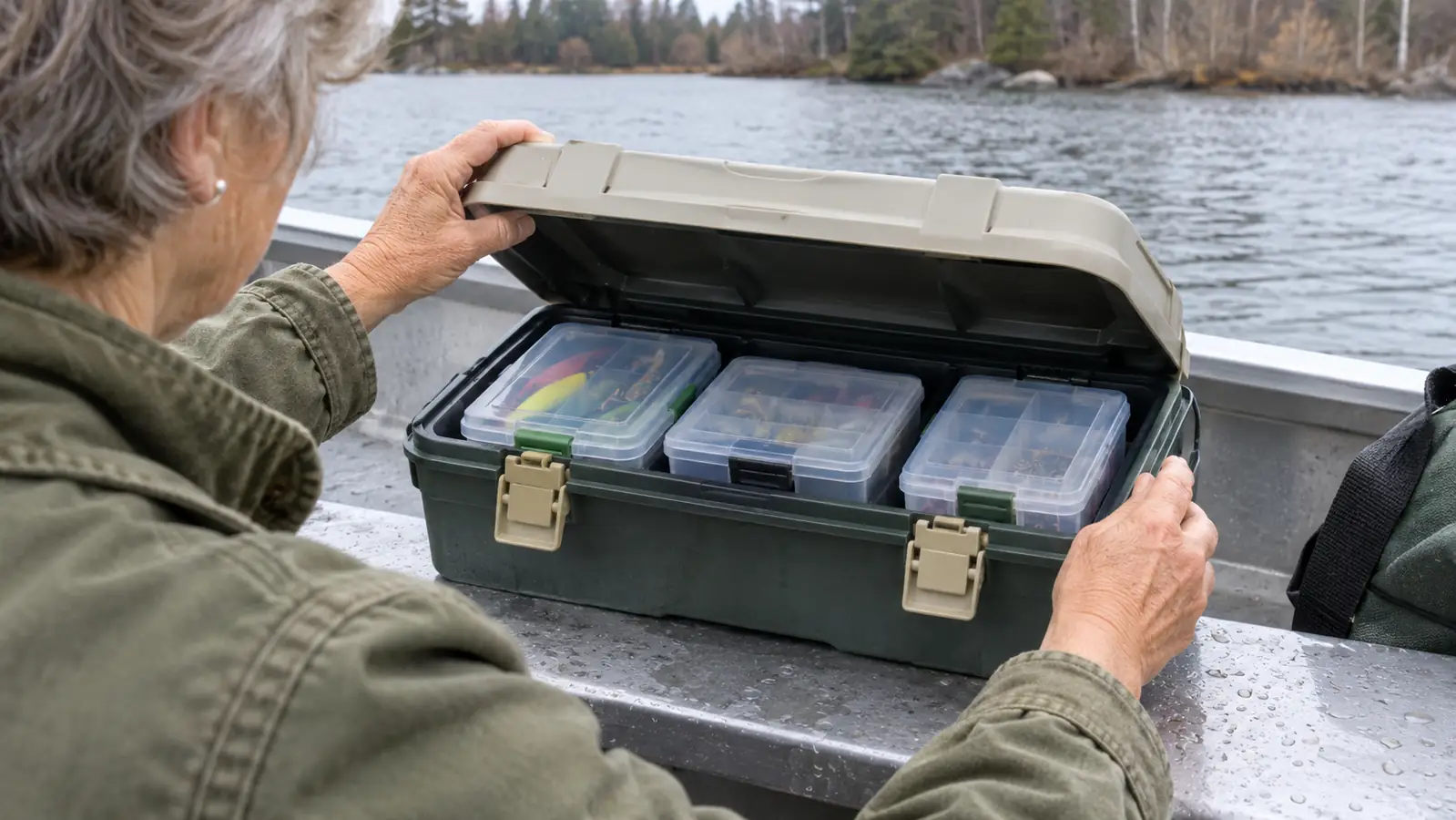
The main compartment presents the utility boxes at a 15 degree angle. That is the one feature everybody mentions and the one feature that actually earned its place. When you lift the lid you are looking down at the tops of the boxes instead of at their sides. You can read which box is which without pulling anything out. On a jon boat bench, with the hull moving a little under you and the light flat and gray, that matters more than it sounds like it would.
In practice it looks like this. I lift the lid, I see the crappie box, I take two or three jig heads, I close the lid. Thirty seconds and I am back on the rod. In the old metal box it was a two-handed job with a tray balanced on my knee and one eye on the wind. That is the honest case for the angle, and I will say it plainly since it is the reason I have kept this box: it is a real improvement, not a gimmick.
Cold mornings are where the angle earns its keep, and I did not expect that. In late November the air off Lake Barkley comes across the water and my hands stiffen up faster than they used to. With the old box I would lay a tray on the bench and pick through it with numb fingers, and I dropped more than one jig head into the bottom of the boat doing it. With this one I lift the lid, look down into the box I want, and shut it. Two fingers, nothing set down where the wind can take it.
The angle is also why the box is as tall as it is. The listed dimensions are 18 inches long, 9.5 inches wide and 11 inches high. That 11 inches is the number to think about before you order. It is taller than my dad's metal box by a good margin and it does not slide under the bench seat of my boat. It rides on the bench or on the floor between my feet while I am running the trolling motor, and I have learned to set it where I will not kick it.
Two and a half years and I have never once had to dig for a jig head. That is the entire case for this box.
The Three StowAway Boxes, and How I Split Them
It comes with three StowAway boxes, and the shell is built around that number. The specs list the capacity at three, and after two and a half years I would not want a fourth in there. Three fills the compartment and keeps every box easy to pull out with one hand instead of pinching your fingers to work one loose.
Here is how mine are split, in case it saves you a Saturday. Box one is crappie jigs, a couple dozen assorted heads and a handful of curly tails. Box two is bass, soft plastics plus a few crankbaits and a couple of spinnerbaits. Box three is terminal tackle, hooks, split shot, swivels, and all the small loose things that used to live in the bottom of the metal box and had to be fished out with a fingertip. That split has held for two and a half years without me changing it. Which tells you the boxes are sized right for a normal amount of tackle.
What gets left home is worth being specific about. I have a shoebox of big swimbaits I bought on a whim years ago and have used maybe four times. It does not fit in the three, so it stays on the shelf. Same for a bag of six-inch worms in colors I have never had a bite on. My rule now is that anything that will not go in the three StowAway boxes is a thing I am not really using anyway, and two and a half years have borne that out more often than not.
And it tells you the limit, too. Three boxes is the ceiling. The shell does not leave room to stack a fourth on top, and there is no outside compartment sized for a bag of plastics you did not feel like sorting. If you carry a serious amount of tackle, this box will make you choose and leave the rest at home. Some people will call that discipline. Some will call it a problem.
What Nobody Tells You: The Parts That Annoy Me
Weight first. The listed weight is 5.7 pounds, and that is empty. Loaded, mine is heavier, obviously, and there are no wheels on this shell, so it is a two-hand carry from the truck down to the ramp. I am 61 and I would rather make one trip than three, so I have gotten in the habit of carrying the box and the net together and letting everything else wait. It is not a complaint about the box so much as a fact about a hard shell that holds as much as this one does.
The bigger complaint is weather, and this is the part I wish someone had put in a review before I bought. The lid is not sealed. I got caught on the water in the fall of 2024, maybe 20 minutes of steady rain, and there was water standing in the bottom of the main compartment when I opened it that evening. Not a flood, nothing ruined, but enough that I pulled all three boxes out and dried them on the workbench overnight. Since then the box rides under a folded poncho in the boat when the sky looks like that. A hard shell is not the same thing as a watertight one, and anybody who tells you otherwise has not left theirs out in the rain.
The DuraView covers on the boxes are the clear lids, and they do what they claim for a while. Mine have gone a little cloudy after two and a half years of sun and lake water. Still readable, still enough to tell the crappie box from the terminal box at a glance. Not a deal breaker. Just the honest state of them, and I would rather tell you now than have you notice it in year three and wonder.
One small thing on top of that. Mine lives loaded in a garage that gets hot in July and cold in January, and nothing has cracked or warped in two and a half years. That is worth saying because I expected it to. But if you live somewhere hotter than western Kentucky and your garage bakes, a hard shell sitting full of tackle in that heat is a thing worth keeping an eye on.
What I Liked
- The 15 degree angle is real. I can see and reach the right box in seconds instead of lifting trays.
- Three StowAway boxes hold a hobbyist's full load of jigs, plastics and terminal tackle in three clear groups.
- The hard shell has taken two and a half years of boat duty in heat, cold and fog without cracking or warping.
- It organized my tackle in one Saturday and the order has held ever since, which is more than I expected.
Where It Falls Short
- The lid is not sealed. Steady rain will put water in the main compartment.
- It is 11 inches tall, so it will not slide under a low bench seat in a small boat.
- 5.7 pounds empty, no wheels, and it is a two-hand carry down to the ramp.
- The clear box covers cloud over with years of sun and water.
What I Compared It To
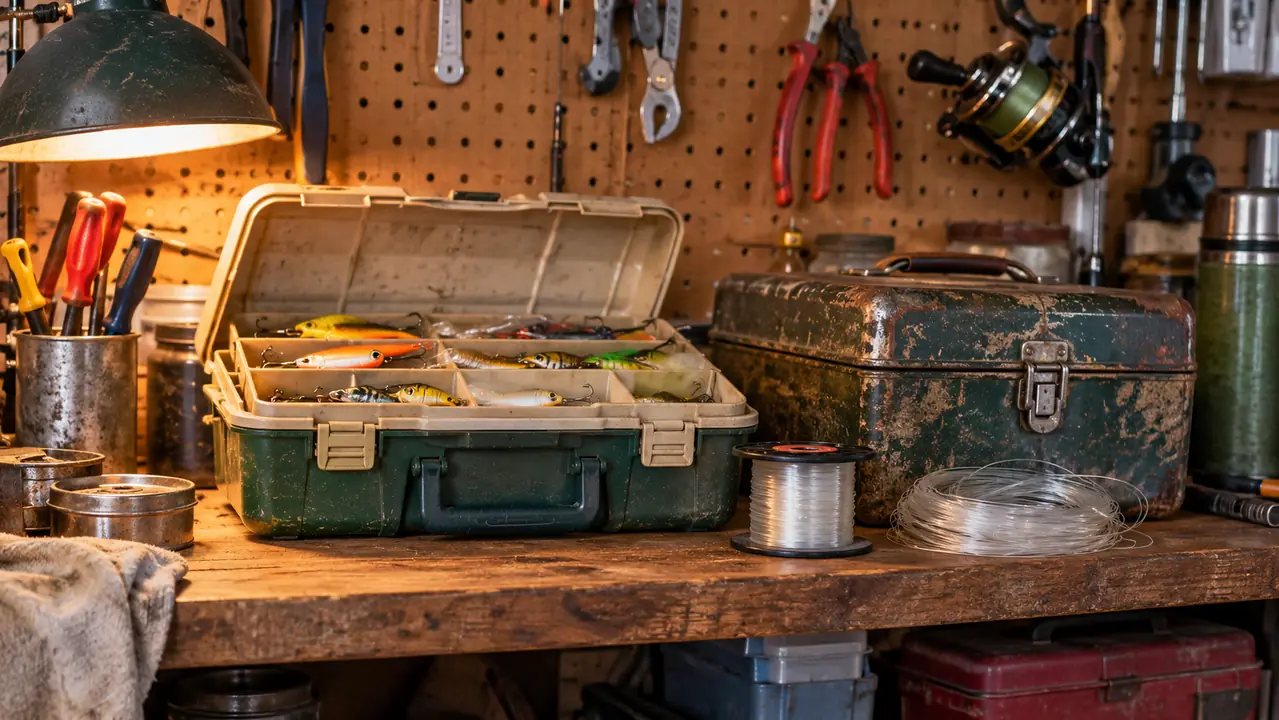
The only other tackle box I have ever owned is the metal one my father left me, and it still lives on a shelf in the garage. It beats the Plano in exactly two ways. It is lighter, and it fits under a seat. Every other way, the Plano won the first weekend. Trays that lift out and get set down on a bench in the wind are a bad design on a small boat, and trays are what the metal box is. I keep it for sentiment, not for fishing.
Friends at the ramp use soft tackle bags and I have looked at theirs and read the listings, but I have never owned one, so take this for what it is worth. The case for a soft bag is weight and the way it squashes into odd spaces. The case for the hard shell is that nothing inside gets crushed, the boxes come out one at a time, and it does not turn into a wet sack when the weather turns. If I fished from a bigger boat with lockers under the seats, I might think differently about that. From a 14-foot jon boat, I want the shell. If you are weighing those two against each other, that comparison is the one worth reading next, because the answer really does come down to what you fish out of.
One thing I noticed on a friend's bag at the ramp last summer. He had it in the bottom of his boat with the lid half zipped, and when we idled across the lake the spray came over the bow and went straight into it. He did not seem bothered. I would have been. That is not an argument against the bag, it is just the reason I have not switched, and I say it knowing his bag weighs a fraction of what my box weighs and he carries it with one hand.
Who This Is For
This box is for the person who carries a moderate amount of tackle, fishes from a small boat or from the bank, and is tired of lifting trays out to find one thing. If you are the sort who wants your jig heads, your plastics and your terminal tackle each in their own place, and you want to grab one item out of the garage and be ready to go, the Plano does that better than anything else I have handled. It suits a hobbyist's load and it does not pretend to suit more. The angle does the work, the boxes stay sorted, and the shell holds up. That is a fair trade for the weight and the height.
Who Should Skip It
Skip it if you carry more than three boxes' worth of tackle, because there is nowhere to put a fourth and no outside compartment to cheat with. Skip it if your only storage is under a bench seat, because 11 inches will not go and you will be tripping over it. Skip it if you fish in the rain with no cover over the boat, because the lid is not sealed and you will spend an evening drying gear on the workbench, same as I did. And skip it if weight matters to you on the walk down to the ramp, because 5.7 pounds plus a full load of tackle is not a light thing at 61 years old. None of those are knocks on the box. They are just the shape of it, and it is better to know the shape before you buy than after.
If you are tired of lifting trays to find one jig head, this is the box
Three StowAway boxes, a hard shell that has taken two and a half years of boat duty, and a 15 degree angle that puts the right box under your hand. Bring a poncho for the rain and you will be fine.
Amazon Check today's price on Amazon →