
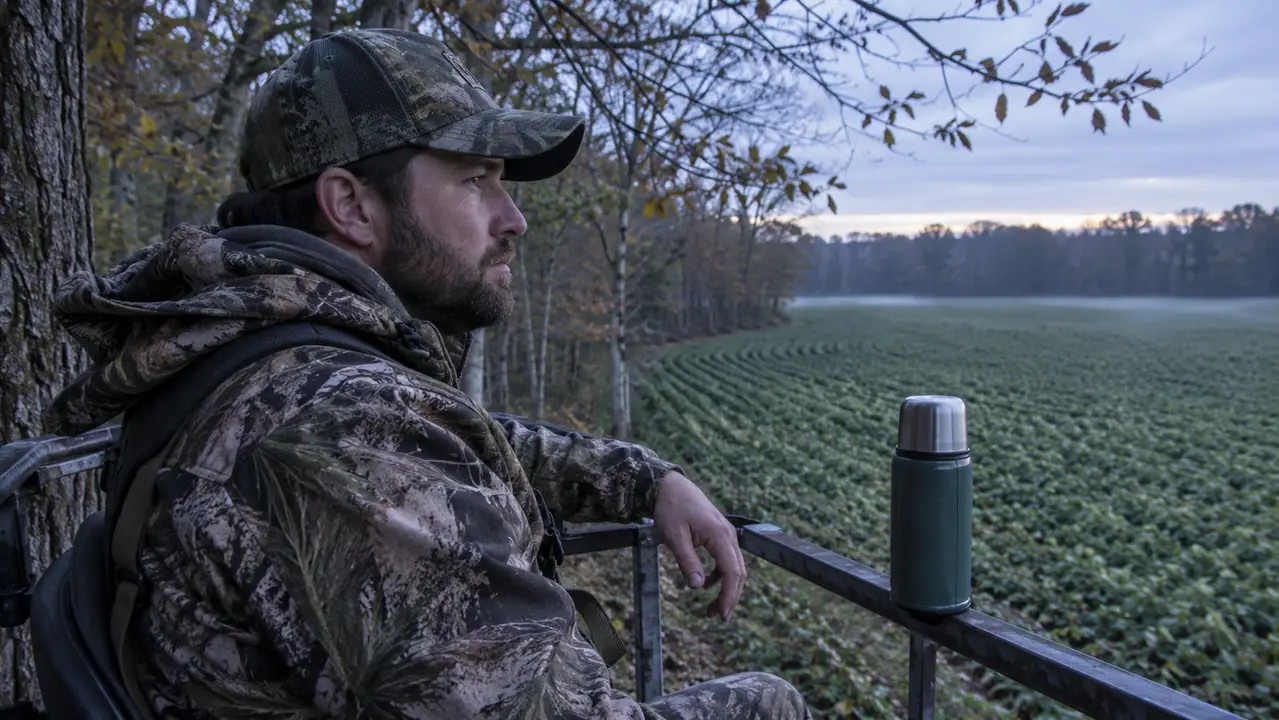
The doe stepped out near the far fence in November 2024 and I guessed her at 150 yards. I shot over her. She ran off unhurt, which is the only part of that morning I am grateful for. I sat in the stand another hour with my hands cold and my ears hot, then walked out and ordered a TIDEWE hunting rangefinder when I got to the house. I had hunted close to 50 years without one. I had a notion that a person who had looked at that many deer ought to be able to judge distance by eye. I was wrong about that in a way that cost me a deer and a morning.
I bought it in December 2024 and I have owned it nearly two years. It lives in the chest pocket of my jacket in its case, and between seasons it sits on the gun cabinet shelf. This is not a piece that will tell you it is the finest glass ever put in a small box, because it isn't. What it is, is a rechargeable rangefinder rated from 3 to 700 yards with 6x magnification. After nearly two years I know exactly what it will do from my stand and what it will not do in the fog. Nobody told me either of those things before I bought it, so I am telling you.
The Quick Verdict
It ended my guessing problem for good, and it does it in a package the size of a deck of cards. The speed function is dead weight to a deer hunter and fog will beat it, but the three ranges I actually need have read true since the week I got it.
Amazon Check Today's Price →One fence line, one missed deer, and a number that never moved
The same rechargeable rangefinder that lives in my jacket pocket from December through the end of gun season. Check today's price and the current listing details on Amazon.
Amazon Check Today's Price on Amazon →How I've Used It
My hunting does not change much. One ladder stand on a big oak at the edge of the bean field, a 15-minute walk from the gate where I park. I am in it well before legal shooting hours, harness on, blaze orange during gun season, and one of the first things I do after I get settled is range the three marks I care about.
The near oak is 48 yards from the stand. The gate post is 96. The far fence, the one that taught me my lesson, is 212. Three readings and I have all three, and then I know what I am looking at for the rest of the morning instead of guessing at it. That is the entire job. I am not ranging every squirrel that comes through. I range three fixed things, once, in the dark, and I put the unit back in my pocket.
The rest of the year it comes out maybe a dozen times. I have ranged trees along the creek bottom out of plain curiosity. I ranged a gate at the back of a neighbor's place once because I was arguing with Ray about it and I was right. It is not a piece of gear I handle constantly. It is a piece of gear that answers one question, and it answers it in about a second.
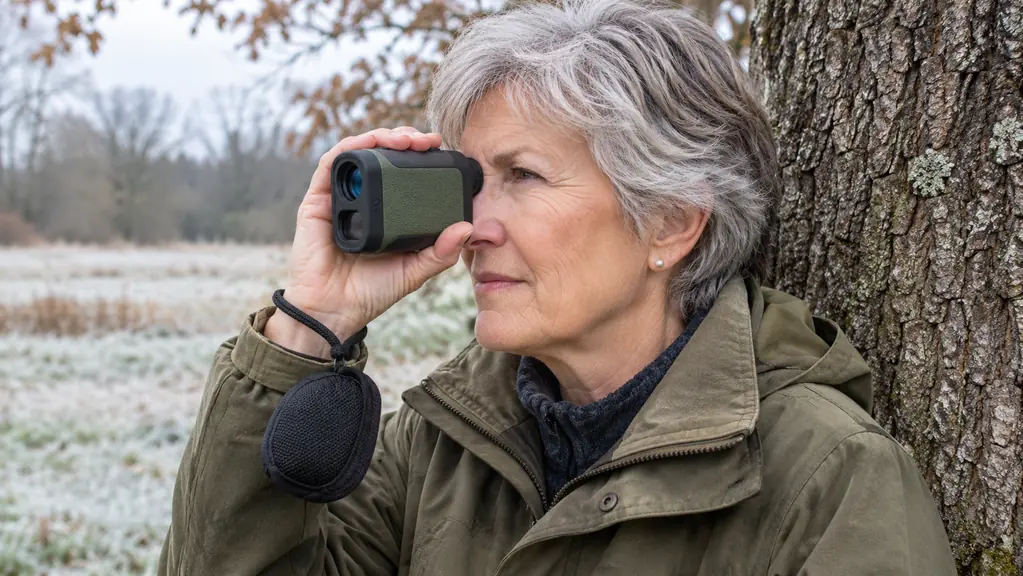
Cold mornings are the real test. A rangefinder is plastic with glass in it, and glass fogs when you bring it up out of a warm jacket too fast. This one has fogged on me twice, both times when I pulled it out quick after the walk in, and both times it cleared in a minute or so held against my chest. That is not a defect, that is physics. But it is the sort of thing I wish somebody had said out loud before I stood in the dark wondering whether I had already broken it.
One thing about the dark that took me a season to learn. Getting a reading before daylight is no trouble, because a gate post and an oak trunk are solid things and the unit does not care whether the sun is up. What it does care about is a wobble. Standing freehand in a ladder stand at 28 degrees, a person will sway, and a sway will give you the reading off the tree behind the fence instead of the fence itself. What works is to brace both elbows on the platform rail, take one breath, let it half out, and press. Do that and the TIDEWE gives me the same number every morning. Do it sloppy and it gives me an answer anyway, because it does not know I asked badly.
What the Numbers Mean Out There, Not on the Box
The listing says 3 to 700 yards and plus or minus one yard. I cannot test plus or minus one yard with the tools I have and I am not going to pretend I can. What I can tell you is that my far fence reads 212 every single time I have tried it, in cold, in light rain, and in that gray half-light before the sun is up. It read 212 the week I got it in December 2024 and it read 212 on the opening morning of gun season last November. A number that does not wander is worth more to me than a number that might be finer.
That 700 yards is a number for a hard target on a clear day and I have never needed it. My own limit is 150 yards, so everything I care about lives inside the first quarter of what this thing will do. If you shoot across open ground at long distance, the far end of the rating will matter to you and I cannot speak to it. From a ladder stand in the hardwoods, the useful window is 40 to 220 yards, and in that window it has been solid as a fence post.
What it will not do is read a soft target at distance. An animal's body at 200 yards in flat light is a harder thing to get a number off than a fence post is, and that is how a laser works, not a knock on this particular unit. Aim at the fence or the tree trunk near where the animal is standing and you get your number. Aim at the animal itself in poor light and you may have to try twice.
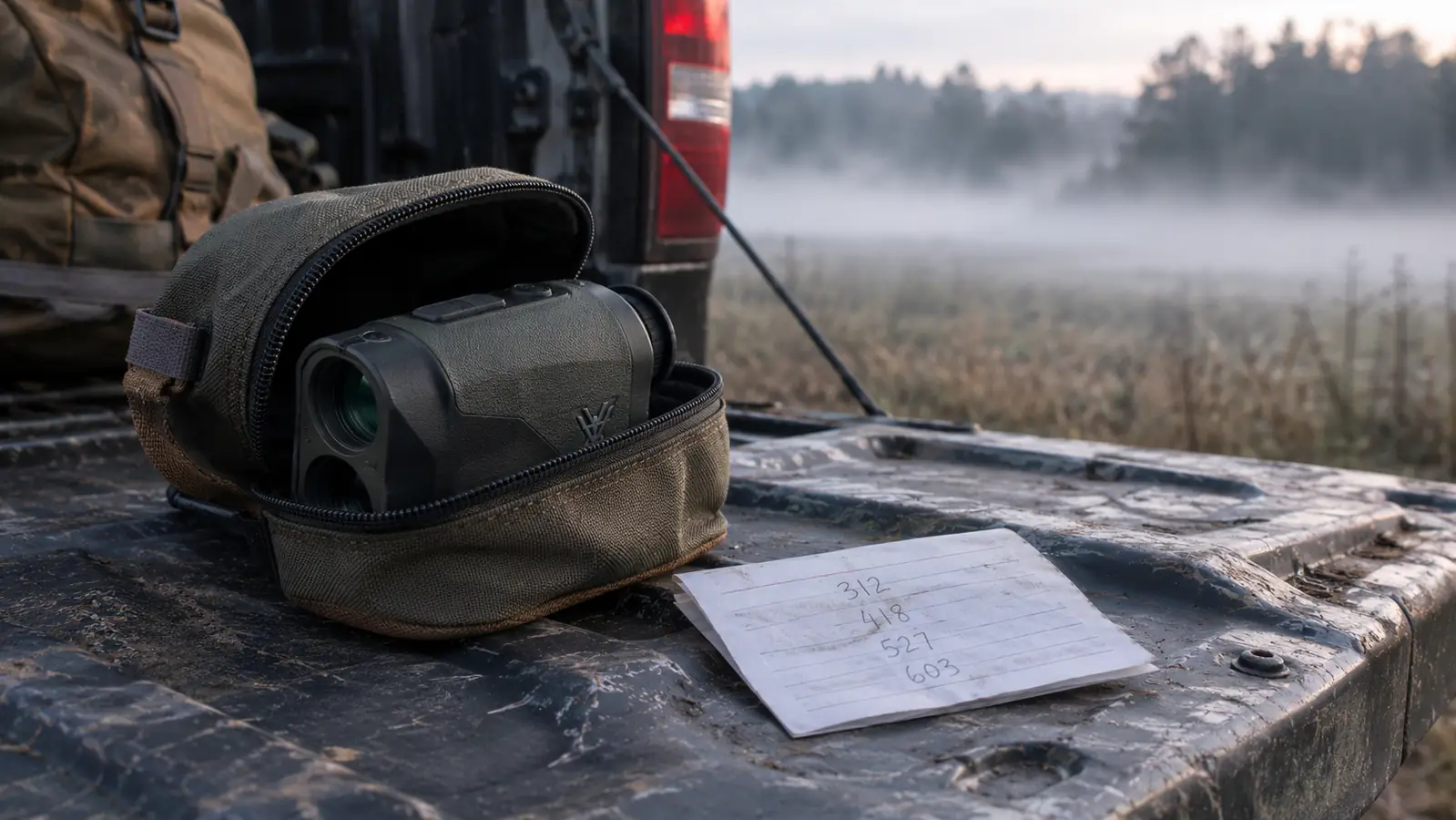
I wrote the three numbers on an index card the first week and it has lived in the glove box ever since. 48, 96, 212. That card is worth almost as much to me as the rangefinder is, because it means I do not have to take a reading at all on a morning when I am running late to the stand. I check the numbers fresh at the start of each season in case a post got moved or a tree came down. They have not moved yet.
The 6x magnification is enough to see what you are pointing at and not enough to turn the thing into a spotting scope. I use it to find the gate post and the fence line. I do not use it to study a deer's headgear, and I would not trust it for that. If you want to judge a buck from 200 yards out, you want binoculars, and this is not binoculars.
It read 212 the week I got it in December 2024 and it read 212 on opening morning last November. A number that does not wander is worth more to me than a number that might be finer.
What Nobody Tells You
The speed function. It is one of the readings this unit offers, and in nearly two years I have used it once, at the kitchen table, out of curiosity. I do not know a soul who ranges a moving animal before pulling the trigger, and I would just as soon the thing did not have it. If you want to know how fast a truck is going down your road, this will tell you. That is not why I bought it and I doubt it is why you will.
The size cuts both ways. It measures 4.13 by 2.61 by 1.49 inches and weighs 5.67 ounces, which is small enough to ride in a shirt pocket and small enough to lose. The case that comes in the box is not an accessory, it is the reason the lens is still clean. I put it back in the case every single time, because a rangefinder rattling loose in a pocket with a truck key and a folding knife is a rangefinder with a scratched lens by February.
The fog will beat it and the rain will make it nervous. It is rated IP54, which means water resistant, and water resistant means spray and weather, not a dunk in the creek. More to the point, a laser needs something to bounce off. On a morning with fog sitting in the bottom, my far fence at 212 will not give me a reading, and it is not the unit's fault. On those mornings I range the near oak at 48 and the gate post at 96 and I let the far fence go. Nothing is standing at 212 in that soup anyway.
It is rechargeable and that is a mixed blessing. I do not buy batteries for it, which I like. I also do not have a battery I can swap at the truck if I forget. What I do is charge it before the season opens and again at the start of the second week, and I have never had it go dead in the stand. If you are the sort who forgets things, set a reminder on your phone. A dead rangefinder is a paperweight in your pocket and it weighs about the same.
The last thing nobody tells you is that the number changes how you sit. I used to look at a deer near that far fence and think 150. Now I know it is 212, I know it is past my limit, and I do not spend twenty minutes talking myself into a shot I should not take. That is worth more than any accuracy figure on the box. It kept me from making the same mistake a second time, which is more than I can say for most things I have bought.
Where It Falls Short
I am not going to pretend this is a piece of gear without faults. It has three that bother me and one that I have made peace with. The faults are on the list below, and none of them are the sort that would make me sell it, but you ought to know them before you decide.
What I Liked
- Reads my three fixed marks the same every time, cold or wet or gray
- Small and light enough that I actually carry it, 5.67 ounces with the case in my chest pocket
- Rechargeable, so there is no battery to buy and none to die at the wrong moment
- The case comes with it and it is the reason the lens has stayed clean
- One year manufacturer warranty, which is a year more than nothing
Where It Falls Short
- The speed function is dead weight to a deer hunter
- IP54 means water resistant, not waterproof, so it stays out of the creek
- Fog cuts the long readings and there is nothing to be done about that
- Small enough to lose, and the case is not optional if you want it to last
- No way to swap a battery in the field if you forget to charge it
What About the Other Brands
I have never owned a Bushnell Bone Collector or any other rangefinder, so I am not going to sit here and rank them against a thing I have not used. What I can tell you is what men at the ramp have said, which is that they like theirs and they have had them longer. I do not doubt it. I bought the TIDEWE because it was rechargeable, it was small, and I could not see paying for readings I would never take.
The honest position is this. If you want the brand that has been around forever and everybody trusts, buy that one. I mean it. If you want a small rechargeable unit that ranges three fixed marks and does it the same every time, this is that unit, and nearly two years have not given me a reason to go looking elsewhere.
Who This Is For
If you hunt from a fixed stand and you have a handful of marks you care about, this will do everything you need and nothing you do not. It is a deer hunter's tool, plain and simple. Range your lanes in the dark, know your three numbers, put it away, and hunt.
It is also a fair choice for a person who has never owned a rangefinder and is not sure they will use one much. That was me. I did not want a piece of equipment I had to learn. I wanted a number. The whole operation is bring it up, press, read, put it away. If that is what you are after, you will not be disappointed and you will not be confused.
One more thing in its favor. It does not require a young person's eyes. I am 61 and I read the numbers without putting my glasses on, and I have read them in the gray light before sunrise more times than I can count. Small consideration, maybe. But I have handled plenty of gear that assumed I could see like I did at 30, and this is not one of them.
Who Should Skip It
If you shoot long, past 300 yards, across open country, the far end of this rating is not where I would put my money, and I would want better glass than a 6x unit gives you. I cannot recommend what I have not used, so I will just say this one is built for the kind of hunting I do and not for the kind I do not.
If you are rough on gear and you want something you can drop in the creek and keep working, skip it. IP54 is water resistant. It is not a submarine. Same if you insist on a battery you can change in the field, or if you want a piece with a lot of settings to fiddle with, because the fiddling is the part of this unit I like least.
And if you are the sort of hunter who wants a gadget to make the decision for him, do not buy this. It gives you a number. What you do with the number is still on you. If you were going to take the shot anyway, the rangefinder will not change that, and you will have spent your morning reading a screen instead of watching the tree line.
Two Years In, Plainly
I have not lost it, broken it, or sent it back, and I do not expect to. The TIDEWE sits on the gun cabinet shelf all summer, comes out in November, and tells me the truth about three marks I have been looking at for most of my life. The fog will beat it some mornings and the speed function will stay unused until the day I die. Neither of those things has cost me a deer. Guessing at 150 yards did, and I am not going back to guessing.
The cheapest thing I know to stop guessing is a number
Same unit, same case, still riding in my jacket pocket every November. If you have a fence line you have been eyeballing for years, range it once and find out what it really is.
Amazon Check Today's Price on Amazon →