
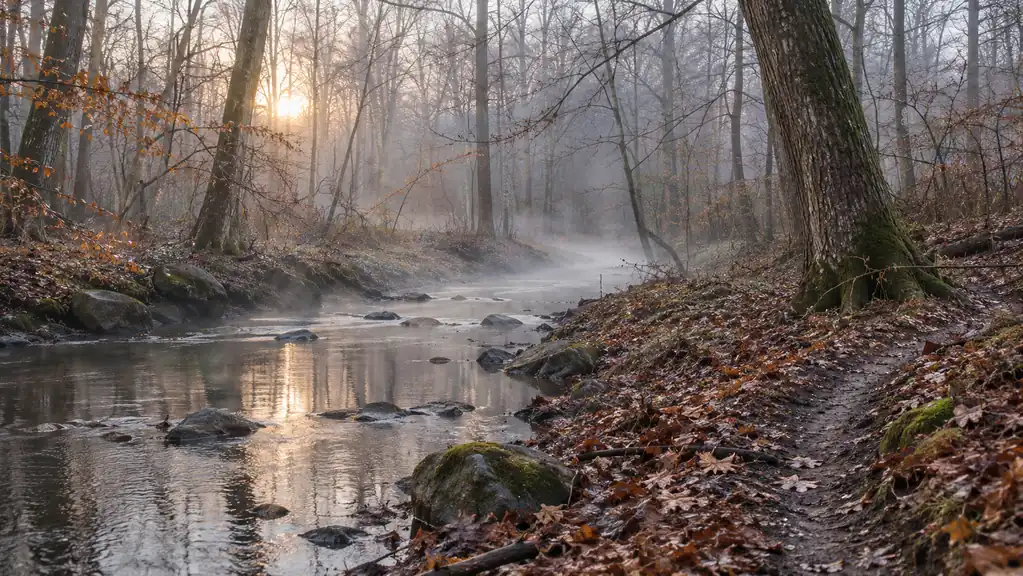
I did not want a trail camera. What I wanted was to keep doing what I had done for close to 50 years, which is sit in the ladder stand at the edge of the bean field and guess. Guess what time the deer moved through the creek bottom. Guess whether the scrape under the white oak was two days old or two weeks old. Guess why the does crossed early some evenings and late on others. I was good at guessing. Guessing is not the same thing as knowing, and at 61 I have run out of patience for the difference.
In August 2025 I bought a WOSPORTS mini trail camera. One camera, and it is the first and only trail camera I have ever owned. No cellular, no Wi-Fi, no app on my phone. About every two weeks I walk down to the bottom, pull the card, and look at the pictures on my laptop. A little over a year of that has taught me more about my own 40 acres than sitting quiet ever did.
The Quick Verdict
Small, light, and genuinely useful on ground you can walk to. It photographs the creek crossing at night, misses some of what moves fast, and never once asked me for a password.
Amazon Check Today's Price →The camera that ended my guessing
One white oak, one card pull every two weeks, and a fall of pictures I could not have gotten any other way. Check today's price before the season turns.
Amazon Check Today's Price on Amazon →How I've Used It
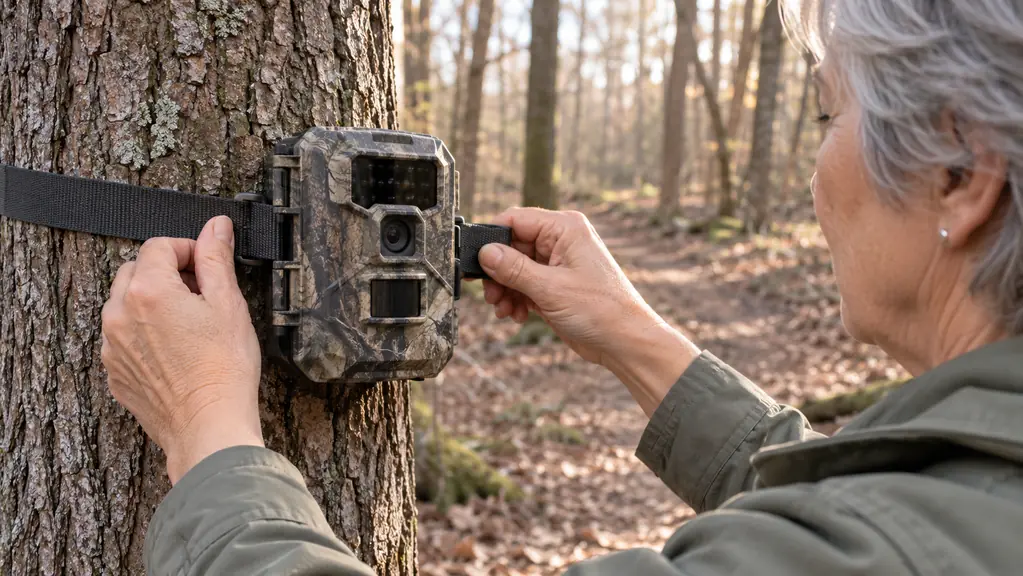
The camera is strapped at about waist height to one white oak where a deer trail crosses the creek in the bottom. That tree is roughly a 15 minute walk from the gate where I park, on the same path I take to the ladder stand, so checking it costs me no extra steps. It has not moved since the first afternoon, when I dropped it two notches on the trunk after deciding it sat too high for the slope. Part of that is that moving a camera every three weeks means you never learn what normal looks like on a piece of ground. Part of it is that I am lazy about some things and honest about it.
The body measures 4.25 by 4.21 by 3.43 inches and weighs 11.68 ounces. The housing is ABS, the mount is a tree mount, and the listing says water resistant, which I have treated as exactly that and not as waterproof. It has been on that tree through one full Kentucky winter and one wet spring with no case over it and no water inside it.
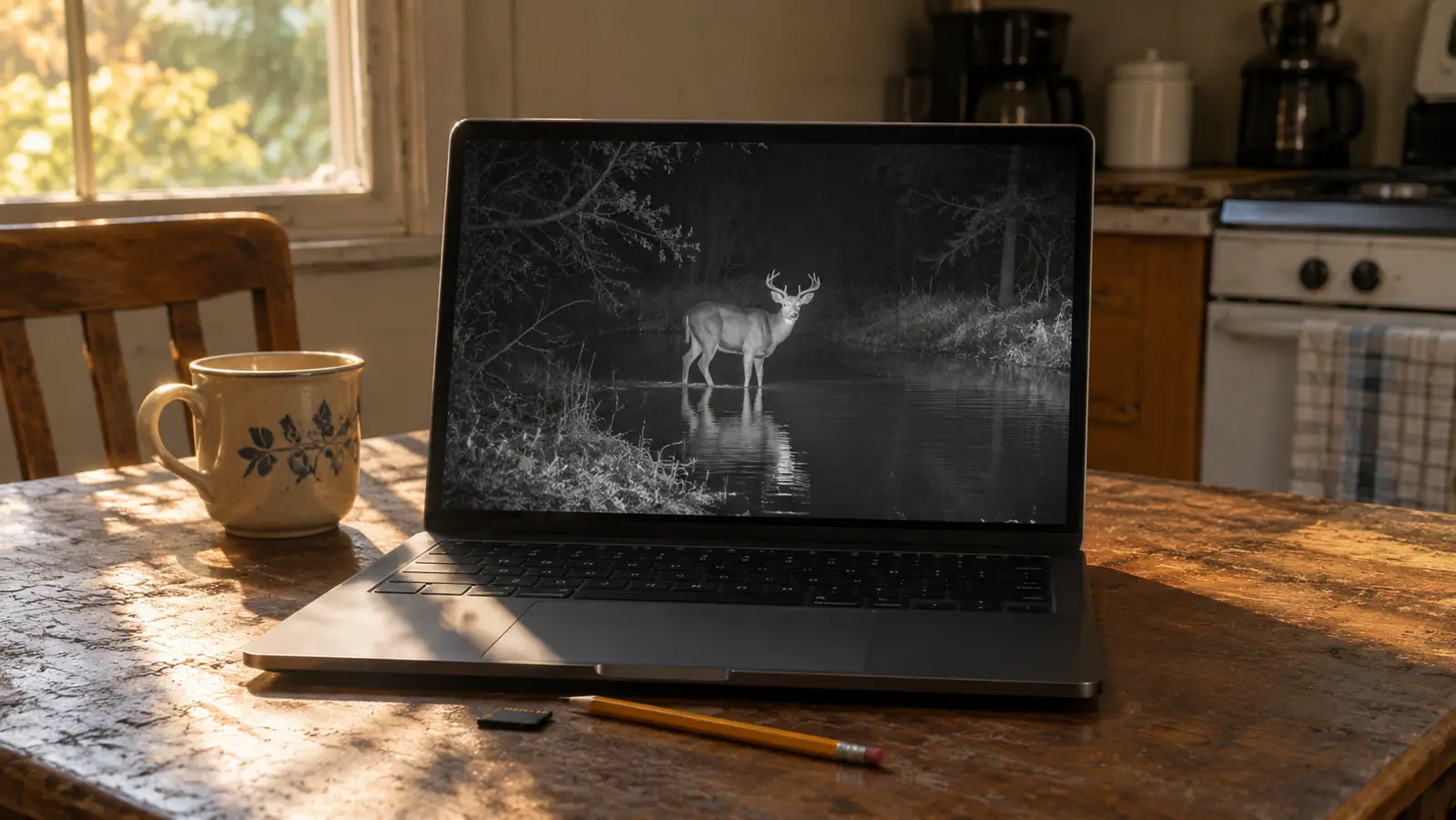
Setup is push button work. The buttons are small, and the first time you do it you will want daylight and your reading glasses. After that it is about a minute: card in, batteries in, strap it to the tree, walk away. The card comes out and goes into my laptop, which is the only device this camera has ever needed to talk to.
The first card pull was squirrels, one doe leaving the frame, and a lesson about aim. The tenth card pull was a coyote at the crossing in the middle of the afternoon, which I had not expected and would not have believed from anybody else's word. You do not get those two facts off a catalog page. You get them by leaving a camera on one tree long enough that it becomes furniture.
I made two mistakes early and both were mine, not the camera's. The first was aiming it at the crossing itself instead of at the trail leading into it, which gave me a lot of pictures of an empty creek and very few of the deer on their way to it. The second was checking the card every three or four days that first month, which told me nothing except that I am impatient. Two weeks is the right interval for me. A camera needs enough time between pulls to have something to say.
I know people who run six cameras and have a wall of pictures to show for it. I am not that person. One camera on one trail answered the question I actually had, which was when deer use that crossing, and it answered it over months instead of over one interesting weekend. If I ever hang a second one it will be on the fence line to the west, and it will be to answer a different question entirely.
What the Numbers Actually Buy You
The WOSPORTS takes 30 megapixel photos and 1080p video. The megapixel number is the one people argue about at the ramp and it is not the number that decides whether a camera is any good. What decides it is whether the picture is sharp enough to count points on a buck at 20 feet in the dark. Most nights it is. I have counted eight points in a night photo, and I have also gotten a gray smear of an opossum where I could tell you the species and nothing else.
One frame from the second week of November is the one I keep coming back to: a doe and two fawns at the water's edge, with the water breaking around their legs. That is a 30 megapixel file doing what it is supposed to do. The same camera on the same night handed me a raccoon that was mostly a shape. Both are honest results from the same tree on the same setting.
Night work runs on 850 nanometer infrared, which gives you black and white pictures and a faint red glow at the camera itself. What deer make of that glow is inconsistent. I have pictures of a doe staring straight into the lens and pictures of deer standing broadside a while later, ignoring it completely. If a camera putting out any visible light at all bothers you, no 850 nanometer unit is going to solve that for you.
The trigger runs off a PIR motion sensor, and the listing calls the trigger fast. What that means in the real world: a deer walking the trail at a walking pace gets caught, usually with room on both sides of him. A deer at the very edge of the frame gets caught half in and half out. Something moving fast gets a hindquarter and a lesson. That is not a flaw in this particular camera so much as it is what passive infrared does when it is watching a fixed line and nothing else.
I use the video rarely. A 1080p clip eats card space I would rather spend on stills, and for scouting I will take twenty frames over one clip every time. The one job video does better is showing how an animal came in, which direction he was walking, and whether he stopped before the crossing or walked straight through it.
The camera did not tell me how to kill that buck. It told me he was crossing in the dark, which is a fact no amount of sitting still could have given me.
The Buck at the Creek Crossing
In October 2025 the camera caught an eight point buck at the crossing. At night, three or four separate times over about three weeks. He came in from the south, stood in the water longer than any deer needs to stand in water, and left the way he came. Same entry, same exit, same hour, every time.
I never saw that buck in daylight. Not once. My stand overlooks ground I know to the yard, the near oak at 48 yards, the gate post at 96, the far fence at 212, and he was not on any of it during legal light. I did not shoot him and as far as I know nobody did.
That buck is the reason I stopped arguing about cameras altogether. I do not know whether a different one would have caught him at a better angle. I know that mine caught him, repeatedly, at the same crossing, at an hour when I was not allowed to be out there with a rifle. I have looked at those frames a dozen times and I still have no good answer for why he stood in that water so long. Some questions a camera answers and some it only makes sharper.
And that is the whole argument for a camera, which has nothing to do with resolution. It is about knowing what your ground does when you are not on it. I had hunted that creek bottom for years and never knew the crossing was a night crossing until I put a camera on it. The camera learned it in two weeks. I had not learned it in twenty years.
Batteries, a Card and Kentucky Weather
It is battery powered. That is the entire power story: no cord, no panel, nothing to plug in, and no reason to run electricity to a tree in a creek bottom. I change batteries on my own schedule rather than waiting for pictures to look wrong, and I keep a pencil date on the card sleeve so I know what I am looking at when I open it on the laptop.
There is no power within a quarter mile of that oak, so the battery part is not a small convenience, it is the whole reason the camera can live there. I have changed batteries five times in a little over a year, and I swap them on the first cool morning in October whether the camera needs it or not, because a camera that goes quiet in the middle of the rut has wasted the only two weeks that mattered.
Two weeks is my interval and it fits the way I use the place. Two weeks is usually 40 to 60 pictures: does and fawns mostly, one opossum that has committed his life to that crossing, the coyote once, squirrels by the dozen, and every so often something with antlers. Pulling the card is a five minute stop on the walk in, and I am already walking in.
The ABS housing and the water resistant rating matter more than people give them credit for. A camera that quits in February is a camera you do not trust by October. The WOSPORTS housing has fogged inside exactly never and the latch has stayed tight through a wet spring. I would not lay it in a puddle to prove a point, and I would not read any water resistant claim past the point of a hard rain.
What 20 Years of Taxidermy Taught Me About Judging a Build
I ran a one woman taxidermy shop out of a converted garage for 20 years and closed it in 2023. That work is mostly looking closely at how a thing was put together and finding where somebody took the shortcut. A trail camera is not a deer mount, but the habit carries over whether I want it to or not.
Three places a lesser build fails first: the latch, the seal where the two halves meet, and the mount. All three have held on this one. The buttons are where I would expect trouble down the road. They are small, and small push buttons are the first thing to go soft on anything that lives outdoors.
Where it comes up short, honestly. It will not read a tag at 60 feet in the dark. It will lose fast movers at the frame edge. A passive infrared sensor gets less reliable as the ground warms through the day, which is true of every sensor of this type and still worth saying out loud. And the biggest limitation is the design itself: nothing comes to you. If you want to know what is at the creek, you walk to the creek.
What I Liked
- Small and light at 11.68 ounces, so it straps to a tree and then disappears from your thinking
- 30 megapixel stills and 1080p video are sharp enough to count points at 20 feet
- 850 nanometer infrared takes usable black and white night pictures
- Battery powered with an SD card, so no signal to chase and nothing reporting to a phone
- ABS housing and a water resistant rating held through a Kentucky winter and a wet spring
- Push button setup takes about a minute once you have done it twice
Where It Falls Short
- Small buttons are hard to work with cold hands or in poor light
- Fast movers and animals at the frame edge get missed entirely
- PIR reliability drops as the ground warms through the day
- Nothing reaches you until you walk out and pull the card
- Night pictures soften considerably at the far edge of the frame
Who This Is For
This is for somebody with a piece of ground they can walk to. Small acreage, family land, a farm they live on or near, a creek bottom they want to understand. If you want to know which trail the does use, what hour the coyotes work that field, and whether the rubs are being made by a deer worth sitting for, one camera on one tree does that work. The WOSPORTS has done it on my place for a little over a year with no drama. It is also a sensible first camera for a hunter who does not want a data plan attached to their season. A little over a year in, I would buy it again for the same job on the same tree.
Who Should Skip It
Skip it if you want pictures on your phone while you sit at the kitchen table. There is no app, no cellular link and no Wi-Fi here, and that is by design rather than an oversight. Skip it if your ground is two hours away and you get there twice a season, because two card pulls a year will not teach you anything worth knowing. Skip it if you are trying to catch a trespasser in the act, since a camera that reports nothing until you drive out is not a security device. Skip it if you would rather be told what is happening out there than go find out for yourself, because the walking is the point, or it is not, and only you know which. And skip it if you need to identify one specific animal at long distance in the dark, because a mini camera on a tree is not a riflescope. Check your own state's rules on trail cameras and legal shooting hours before you hang anything, the same as I did.
Put it on a tree and learn your own ground
One camera, one oak, one card pull every two weeks. That is the whole method. Check today's price and get it out before the leaves come off.
Amazon Check Today's Price on Amazon →