
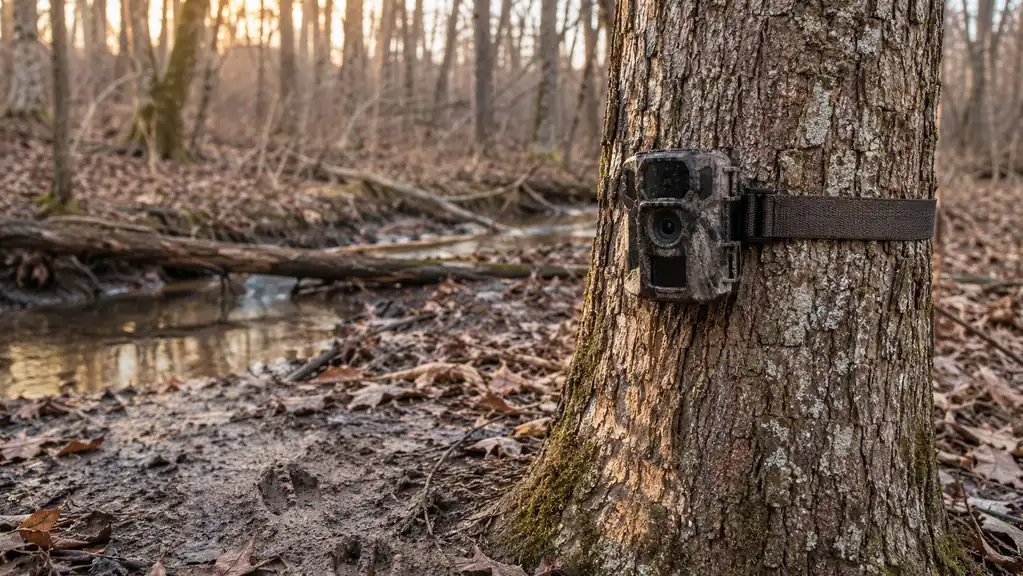
Two things live on the same white oak in the creek bottom on my place: a deer trail, and a WOSPORTS mini trail camera. That is the whole of my trail camera experience. I bought it in August 2025, strapped it at about waist height where the trail crosses the water, and it has not come off that tree since. So when somebody at the ramp asks whether they ought to spend the extra on a cellular camera, I answer from the only place I can: one camera, one tree, a little over a year, and a fair amount of time spent looking at what came back on the card.
Here is the short answer. If your deer are a short walk from where you park, and you do not mind a twenty minute round trip to see what walked by, the WOSPORTS does the job and it does it with no data plan and no app. If your ground is an hour away, or your work keeps you from getting out every week, a cellular camera is the better tool and I will not pretend otherwise. The real difference between the two is not picture quality. It is how much work stands between the animal and your eyes.
| WOSPORTS mini trail camera | Cellular trail camera | |
|---|---|---|
| Getting the pictures | You walk out, pull the SD card, and read it on a laptop | Sends photos to your phone over a cell network |
| Signal needed | None at all | Needs usable coverage where you hang it |
| Ongoing cost | Batteries and a card, nothing else | A data plan on top of the camera itself |
| Setup | Strap it, set it with the push buttons, walk away | Activate it on a plan and sort out the account before anything sends |
| Files you keep | 30MP photos and 1080P video stored on the card | Images arrive compressed to save data; the full files stay on the card |
| Checking from home | Not possible. No app, no Wi-Fi, no remote anything | Check it from the couch |
| Night work | 850nm infrared illumination | Infrared as well, with the same basic limits in thick cover |
| Size and weight | 4.25 by 4.21 by 3.43 inches, 11.68 ounces | Usually bulkier, because the radio and antenna take up room |
| Weather | Water resistant ABS housing | Sealed against weather too, on the models I read about |
| Best for | Ground you can walk to every couple of weeks | Ground that is far off or hard to reach |
Where the WOSPORTS Wins
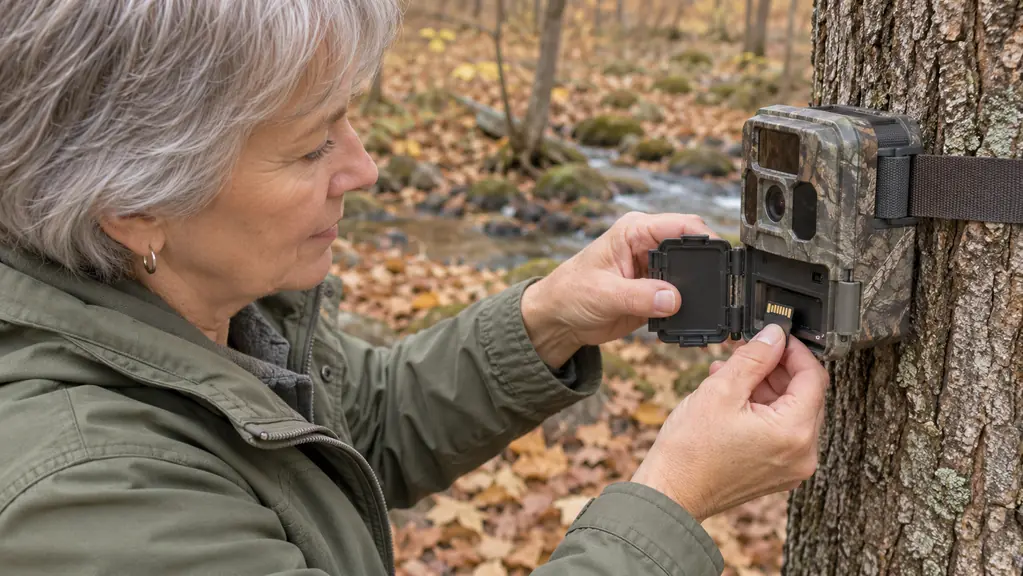
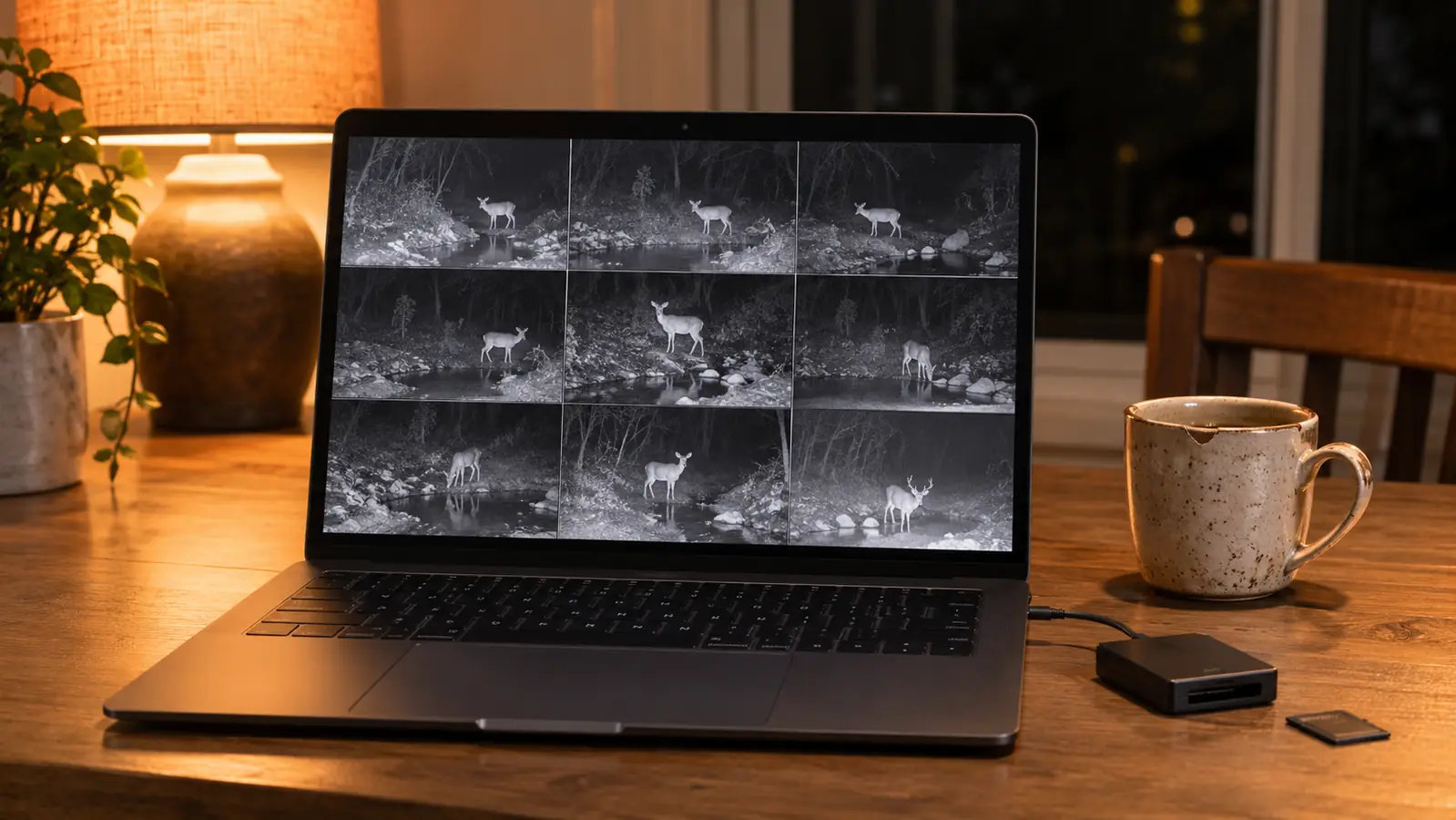
The first thing it wins on is the part nobody prints on the box: after you hang it, it asks nothing of you. There is no account to keep alive, no plan to renew, no app that wants updating in February when all you want to know is whether a buck is still using the creek. I put batteries in it, I set it with the push buttons, I latch it, and I walk away. When I want to know what happened, I drive out, pull the card, drop a fresh one in, and read it on the laptop that night. The camera works with a laptop through that card and that is the entire system. Nothing about it can expire on me.
The second is that it works where the deer actually live. My creek bottom is low, thick, winding ground with hardwoods crowding both sides, and cell coverage down in it is not a thing I would bet a season on. A camera that has to push a picture out of that bottom has to be lucky. This one only has to be strapped on tight and left alone. It is water resistant, not waterproof, so I hung it under a shelf of limbs rather than out in the open, and the ABS housing came through a western Kentucky winter and a wet spring without a crack or a fogged lens. That is not a hard test. It is the test I have.
The third is size. It measures 4.25 by 4.21 by 3.43 inches and weighs 11.68 ounces, which means it rides out in a coat pocket with a spare card and I never think about it. A bigger camera on that tree would catch the eye of anybody walking the fence line, and while I have never had a thing taken, I would just as soon not advertise. A small camera on a decent strap also sits still. A camera that sways in the wind spends the night taking pictures of the same empty branch, and you get to delete every one of them.
Where a Cellular Camera Wins
I have never owned one. I have read the listings and I have listened to two men at the ramp who run them, and that is not the same as owning one, so take this part the way you would take anything secondhand. The case for cellular is not complicated and it is not small. The camera sends the picture to your phone. You do not drive anywhere. You do not pull a card. You find out over breakfast that something with a good set of shoulders came through at 2:40 in the morning, and you have the whole day to decide what you think about it.
For a man whose ground is an hour from the house, that is not a convenience, it is the difference between scouting and guessing. I can be at my gate fifteen minutes on foot from where I park. He cannot. He checks his camera on a Tuesday night from the couch. I check mine on a Saturday, if the weather is fit and I have the time to spare. Over a season that is not a small gap in what you know. It is most of the gap. He knows the week the does start moving in daylight. I find out the following weekend, and some years that is already too late to do anything useful with it.
The camera for ground you can walk to
The WOSPORTS mini trail camera has been on the same white oak since August 2025. No plan, no app, nothing to renew. Pull the card and read it on your laptop.
Amazon Check Today's Price on Amazon →What the Numbers on the Box Actually Mean
Thirty megapixels is more than I need and I will say so plainly. The number I care about is whether I can tell one animal from another, and at the creek crossing I can. I counted eight points on a buck in a night photo, and I could see a notch out of one ear on a doe I had been watching for two seasons. Video is 1080P, which is plenty for me. I do not run video much, because it fills a card in a hurry and I would rather have forty stills of forty different deer than one clip of the same deer walking away from me.
The trigger is the PIR motion sensor, and the honest report is that placement matters more than the trigger does. Hung at waist height and aimed up the trail so the deer come toward it, mine catches them at the front edge of the frame instead of the back. Aimed across the trail, it catches tails and hind ends. That is not the camera's fault, it is mine, and I fixed it by moving the camera once in the first month and never again. It also fires on coons, and on one very determined squirrel. That is the price of a sensitive sensor, and I would rather delete a hundred coon pictures than miss the one deer I was waiting on.
Night work is 850nm infrared, and the results are what you would expect from it. Animals close to the camera come out clear and gray. Something at the far edge of the frame is soft, and you will not judge its size from that picture. The night photos are not pretty and they are not meant to be. They are a record of what walked through while I was asleep. It runs on battery power at 12 volts and 5 watts, so batteries are the whole of your upkeep. Mine has gone about two months on a set in mild weather and less in a cold snap, and since I pull the card every couple of weeks anyway, that is a good time to look at the batteries too.
He came through the creek crossing four nights running in October and never once in daylight. I would not have known that without a camera on that tree.
What It Does Not Do
It does not tell you anything while you are sitting at the house. That sounds obvious and it is the whole argument, so I will say it plainly: a picture taken on a Tuesday that you get to on a Saturday puts you four days behind. Some seasons four days is nothing at all. Other seasons it is the difference between knowing and wishing. If your only free day is Sunday and the deer are moving Tuesday through Thursday, this camera will hand you a very good record of a week you already missed.
It does not identify anything for you, it does not sync anywhere on its own, and it will not survive a dunk in the creek. Water resistant is a real claim and I believe it, because mine has been out in rain and fog and kept working. Waterproof is a different claim and nobody at WOSPORTS made it, so do not take mine as permission to hang it over open water. And it will not sort your card. Some nights you will go through two hundred pictures of a moving branch to find one doe, and that is the job.
A Year on the Back Forty
The thing the camera gave me was a buck. In October 2025 he came through the creek crossing at night, four different nights in about two weeks, always after dark, always alone. Eight points, good mass in the shoulders, and I could see him plain in the infrared. I never saw him in daylight, not once all season. He was not on my ground during shooting hours. I did not shoot him, and as far as I know nobody did. Before I hung that camera I would have spent the whole of November hunting a deer that only used my place after legal hours, and I would have called it bad luck and blamed the moon.
The routine is the part nobody mentions. Every couple of weeks, and every week in late October, I walk out with a fresh card, unclip the camera, swap the card, and walk back. That is twenty minutes if I do not stop to look at tracks. Then in the evening I put the card in the laptop and go through it. Two hundred pictures off a bean field edge is exactly what it sounds like: a few does, a great many coons, one squirrel, and every so often a frame worth sitting up straight for. This is not scouting for a person in a hurry, and I would not sell it to you as such.
Small frustrations, since I promised to tell them. The infrared emitters give off a faint glow that a deer can notice if it happens to be looking straight at the camera, which is one more reason mine faces up the trail so most of them are past it before it fires. A branch moving in the wind will hand you fifty pictures of nothing. And every so often a night photo is soft enough that I cannot tell a big doe from a small buck, which is the camera, the distance and the light all working against me at once. None of that has made me want to take it off the tree.
Who Should Buy Which
Buy the WOSPORTS if your ground is close enough to walk to and you will actually walk to it. Buy it if you run one or two cameras and you do not want another bill in your life. Buy it if your best spot sits in a bottom or behind a ridge where a signal is a gamble, because a camera that cannot send a picture still takes one. Buy it if you are new to cameras the way I was, and you would rather learn placement and card habits first without also learning an app. What you give up is time, and you should know that going in. You will always be a few days behind what is really happening out there.
Buy the cellular one if your ground is far, if your work keeps you from getting out, or if being a few days behind is the difference between a season and a wasted tag. Buy it knowing you are taking on a data plan, a signal requirement, and a device that wants charging and updating. Plenty of people I know run both, a cellular camera on the far piece and a cheap card camera on the close piece, and that is probably the honest answer for a serious hunter. Whichever way you go, check your own state's rules before you hang anything. Camera rules vary from state to state and they change, and the fellow at the ramp is not a reliable source on the law. Mine sits on private family ground and I keep it there.
A camera that asks nothing of you after you hang it
Thirty megapixel photos, 1080P video, 850nm infrared night work, and a card you read on your own laptop. It has been on the same white oak since August 2025.
Amazon See Today's Price on Amazon →