
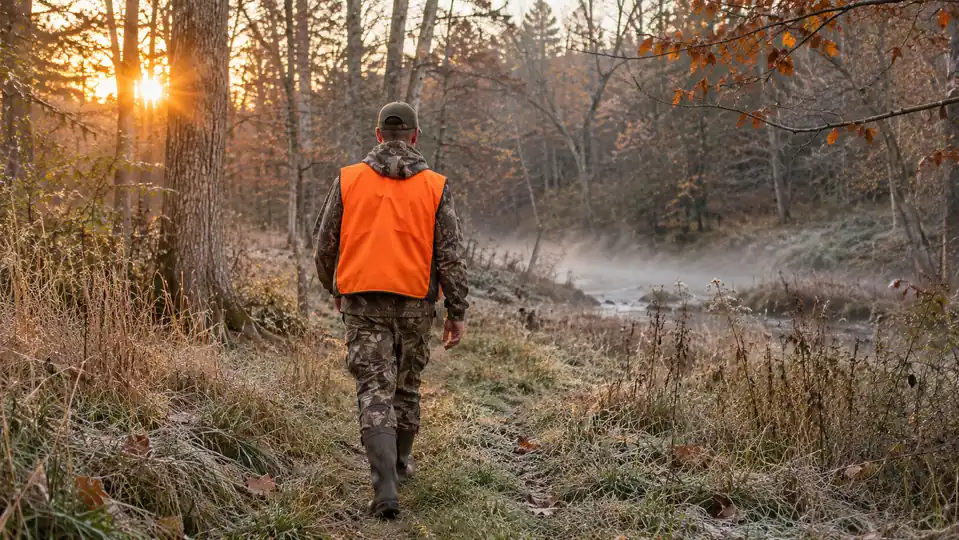
A trail camera does not scout deer for you. I want to be plain about that up front, because it is what I expected when I finally bought one. What a camera does is watch one small piece of ground while you are somewhere else, and it tells you the truth about that piece of ground. Pick the ground well and you learn something you could not have learned any other way. Pick it badly and you get two weeks of raccoons and a lesson about raccoons.
I bought the WOSPORTS mini trail camera in August 2025. It is the only trail camera I own, one camera, and I am not a guide and I do not test gear for a living. I am a retired taxidermist who spent twenty years looking hard at animals and at other people's workmanship, and I have hunted the same 40 acres outside Cadiz, Kentucky for close to 50 years. I strapped that camera at about waist height to a white oak where a deer trail crosses the creek in the bottom, and it has stayed on that tree. This is how I would do it again from scratch, in the order I would do it.
One camera, one tree, one honest season
The WOSPORTS mini runs on batteries, writes to an SD card, and has no signal to chase and no app to pair. You walk out, you pull the card, you look at it on your laptop. That is the entire system.
Amazon Check Today's Price on Amazon →Step 1: Put It Where the Sign Already Is
Do not buy the camera and then go looking for a tree. Walk the ground first, in the off season, with nothing in your pack. Look for tracks pressed into the mud at a creek crossing, droppings under a cedar, a line of rubs on saplings the size of your wrist, scrapes raked under a low limb. That is not you guessing where a deer might be. That is the deer telling you where it already goes, and it wrote it down in a language you can read if you slow down.
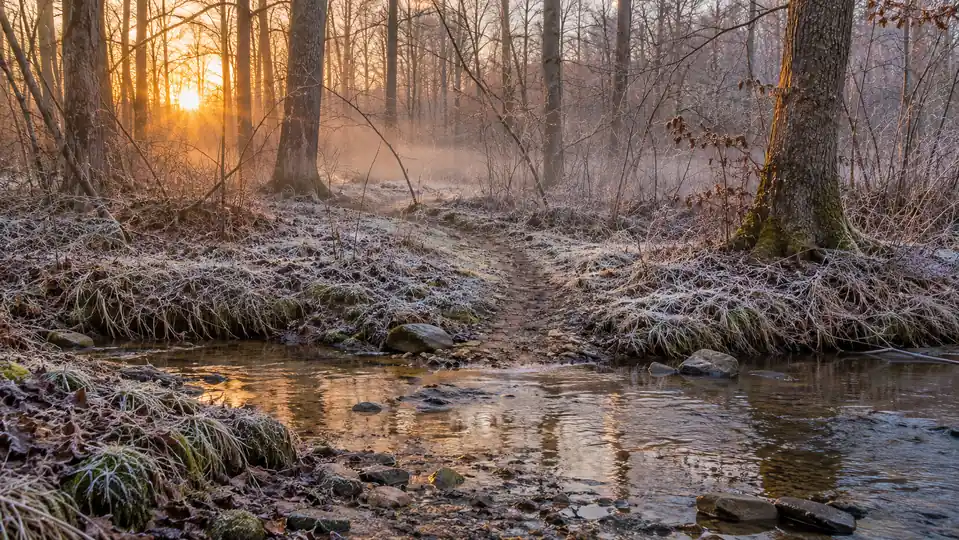
On the back forty the sign has never moved far. The bean field sits up on top, the hardwoods are on the slope, and the creek runs through the bottom. That trail crosses the creek at one narrow place where the bank is worn down to bare dirt and the water runs shallow over gravel. That is the white oak I strapped the WOSPORTS to. It watches that crossing and nothing else, not a house, not a road, not a neighbor's fence line.
A creek crossing is a fine first spot because it pinches deer into one place. So is a fence gap, a saddle between two rises, or the edge where a thicket meets open ground. What you are hunting for is a spot where a deer has no good reason to go around. Two trails running parallel through open timber will split your pictures and teach you half as much.
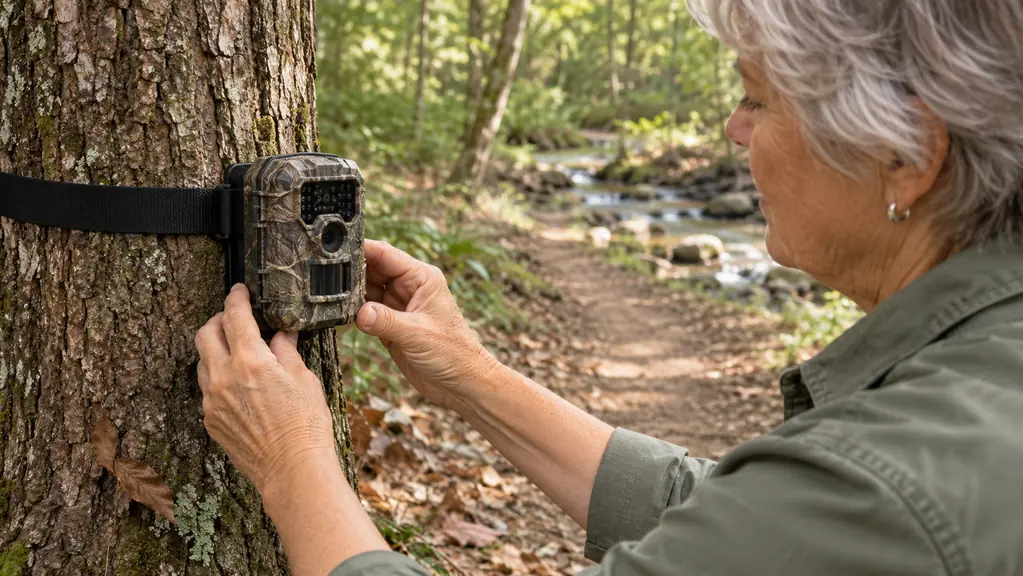
Step 2: Hang It at About Waist Height and Aim It Along the Trail
Waist high on a man, a touch lower if the ground slopes. Higher than that and you photograph the top of a deer's back and a lot of empty air. Lower and the grass grows up in front of the lens by the second week of September. The WOSPORTS is a small box, 4.25 by 4.21 by 3.43 inches and 11.68 ounces, with a strap and a tree mount, so it does not need a big trunk or a heavy bracket. A white oak the size of my two hands together holds it fine.
Aim it down the trail at a slight downward angle, not square across it. A deer walking the trail toward or away from the camera stays in frame far longer than one crossing at 90 degrees. Clear the weeds and the briars out to about ten feet in front of the lens. Anything that moves in the wind will trip the motion sensor, and you will walk out expecting deer and come home with four hundred pictures of foxtail.
Face it north or south if the ground gives you the choice, so the sun is not coming up or going down straight into the lens. Then get the strap tight enough that you cannot rock the camera with one finger. A camera that shifts on the tree gives you tilted pictures, and tilted pictures are hard to read for direction of travel, which is the thing you actually want.
Step 3: Set It, Then Get Out of There
The WOSPORTS is push button, battery powered, and it writes to an SD card. There is no signal to check, no app to pair, nothing to log into and no account in your name. That is exactly why I bought it. I put the card in, put the batteries in, set the date and the time, set it for photos, and shut the door.
I run photos, not video. Thirty megapixel stills give me the time, the date, the direction of travel and enough detail to sort one buck from another. The camera does shoot 1080P video and I have looked at the video, and it is worth doing once to watch how a deer works a scrape. But for scouting, a stack of stills tells me more in less time.
Get in and get out clean. I wear gloves, I handle the camera no more than I have to, and I go in the middle of the day with the wind in my face on the walk in. That is not superstition. A camera that smells like a person, sitting on a trail a deer uses every night, is a camera that gets its picture taken from thirty yards with nothing in the frame.
And read your own state's rules before you hang anything. Rules on trail cameras, on when you may be in the woods, on legal hunting hours and on bait differ from state to state and they change. I do not bait and I would not tell you to. I also will not tell you the camera is a substitute for a license, a safety harness, or knowing where your 150 yards ends.
Step 4: Pull the Card on a Schedule and Read It the Same Day
I walk out about every two weeks and swap the card. Two weeks is long enough to show a pattern and short enough that I still remember what the weather did on any given night. The camera stays on the tree. Only the card comes home, and the spare goes in.
I read it that evening, the same day, while the walk is still in my head. I care about three things on each frame: the time, the date, and which way the deer is pointed. A doe that comes through at 6:40 in the evening three days running is a pattern you can plan around. A buck at two in the morning is not a hunting plan, it is information, and it is worth exactly what you paid for it.
Expect most of the card to be nothing much. Raccoons, a possum, a stray cat, a branch that swung. The night frames come back without color, which is how infrared works, and some of them will be a deer's hind end leaving the frame or a smear where an animal was moving. That is the honest cost of a camera this small, and I would rather have a blurry picture than no picture at all.
Step 5: Move It When the Sign Moves
A camera is not a monument. If two card pulls in a row give you does and coons and nothing with antlers on its head, walk the ground again and find better sign, then move the camera to it. The worst thing you can do is leave it on the same oak until January because that is where you hung it in August.
The bean field gets cut in the fall, and when it does, the deer shift with it. The trail through the creek bottom takes more traffic once the field is bare, and the same camera that saw six deer a week in September may see twenty in November. That is the argument for one camera on the right bottom over three cameras scattered wherever you had a spare strap.
Here is what the camera does not do. In October 2025 the WOSPORTS caught an eight-point buck at that creek crossing, at night, several times. I have the frames. I never saw him in daylight and as far as I know nobody ever did. The camera proved he existed. It did not put him in front of my stand and no camera will. Some deer are simply nocturnal, and learning that is worth something even when it is not the thing you were hoping to learn.
What Else Helps
A headlamp, first. The walk from the gate to the stand is about fifteen minutes in the dark, and I have made that walk with a handheld flashlight and I have made it with a rechargeable headlamp that leaves both hands free. The headlamp wins, on the low red setting, every time. Mine came in a two-pack in October 2024 and one of them lives on the kitchen counter to charge.
Second, a rangefinder, though not for the camera work. I range the three marks from the stand before light each morning: the near oak at 48 yards, the gate post at 96, the far fence at 212. I know those numbers because I checked them more than once, and checking them is why I know the far fence is well past my own 150-yard limit.
Third, a spare card and spare batteries that live in the truck. Not because anything of mine has failed, but because a two-week pull that ends with a dead card is a two-week pull you have to do over. Fourth, patience with the whole business. A camera tells you what uses one crossing. It does not tell you where every deer on the property beds, and if you want that answer you put in the walking, and you will still be wrong about half of it.
And a word on the cellular cameras, since somebody at the ramp always brings them up. They will save you the walk and they will charge you every month for the privilege, and they need a signal where the deer are, which is not always where the signal is. I walk. My card costs me nothing and it has never once told me I was out of data.
In October 2025 the camera caught an eight-point buck at the creek crossing, at night, several times. I never saw him in daylight. The camera proved he existed. It did not put him in front of my stand.
It watches one crossing. Pick the right one.
The WOSPORTS mini is a small battery powered camera with a motion sensor, 30MP stills, 1080P video and infrared night vision, and it writes to an SD card you carry out to the tree. No plan, no signal, no app. Find the sign, hang it at waist height, pull the card every two weeks.
Amazon Check Today's Price on Amazon →