
The first time I pulled the card from the WOSPORTS mini trail camera, I had forty-some night photos of the same creek crossing and one question: was any of it worth the walk? I am 61. I have hunted and fished close to 50 years, and I ran a one-woman taxidermy shop out of a converted garage for 20 years before I closed it in 2023. That work taught me to look at how a thing is built. A deer's ear, a customer's mount, a plastic housing. You can tell a lot by the seams and by what the maker leaves out. So this is not a love letter to a gadget. It is what I found after a little over a year with one camera on one white oak, and the parts of the listing that do not tell you the whole story.
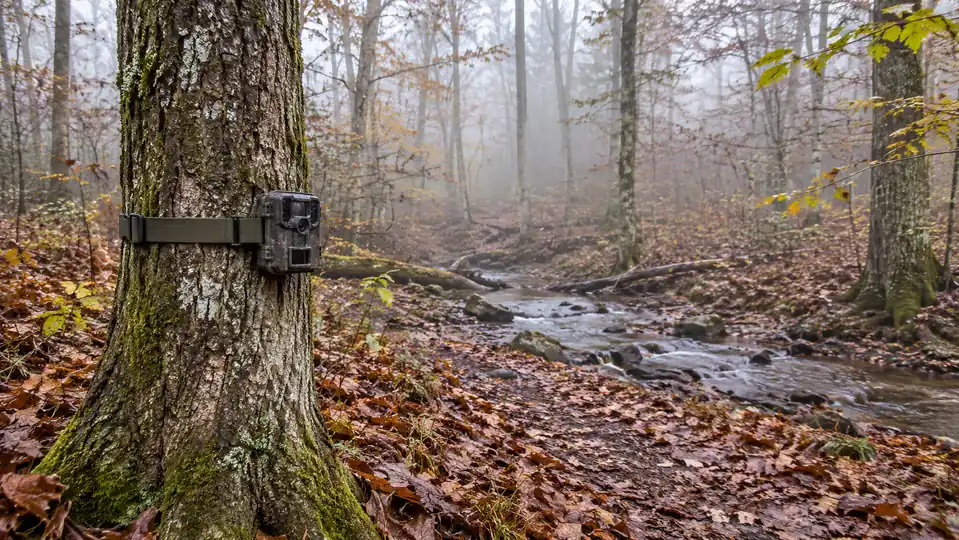
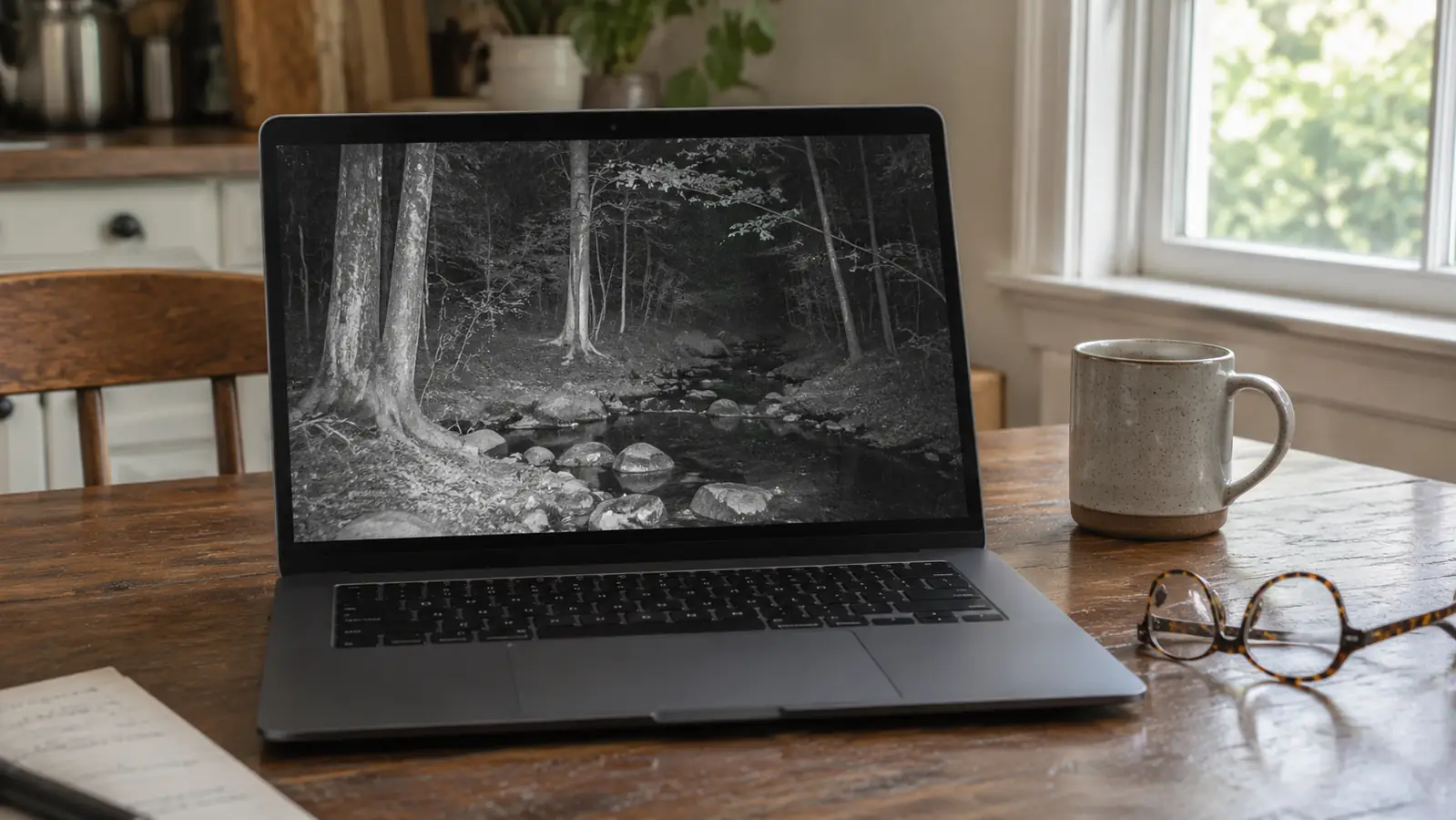
I bought the WOSPORTS camera myself in August 2025. It is my first and only trail camera. I strapped it at waist height to a white oak where a deer trail crosses the creek in the bottom of our 40 acres outside Cadiz, Kentucky. It has stayed on that tree. It watches the creek crossing only, never the house, never the road, never a neighbor's land. About every two weeks I walk out, pull the SD card, and look at it on my laptop at the kitchen table. That is the whole routine. No phone, no app, no signal. If that sounds like too much trouble, this is not the camera for you, and I will say so again before the end.
The Quick Verdict
A plain, compact camera that does daylight and close night work well, then makes you walk out for the card. Buy it for one creek crossing, not for a long fence line.
Amazon Check Today's Price →One camera on the crossing you actually check
If that is the kind of scouting you do, the WOSPORTS listing has the full specs and the current details.
Amazon See the full listing on Amazon →What Nobody Tells You About the 30MP Number
The listing leads with 30MP photos and 1080P video, and those numbers are real. The camera takes a 30-megapixel still and records 1080P video. What the listing does not say is that a 30MP file is big. It fills a card faster than a smaller file, and it takes longer to look through a folder of them on a laptop. I still shoot the 30MP setting because I would rather have the detail when a deer is at the edge of the frame. But I do not pretend the number makes a blurry deer sharp. A big file of a moving animal is still a big file of a moving animal.
When I pulled the card the second time, in early September, the folder held more files than I expected for two weeks. The camera triggers on motion, so a squirrel working the same spot leaves a pile. I scroll the daytime pictures fast and slow down on the night ones, because the night ones are where the question usually is. The 30MP file also makes each one slower to open on an old laptop like mine. That is a small thing twice a month. It would not be a small thing daily.
The second thing nobody tells you is that the word waterproof in the title is not the same as the spec sheet. The spec sheet says water resistant, and that is how I treat it. The housing is ABS plastic, and it has been through rain and fog on that tree without quitting. I have not dunked it, and I would not. If you leave a camera out in weather, water resistant is a real rating, but it is not a promise that you can drop it in the creek. The creek is right there. I keep that in mind.
The camera is small. The listed size is 4.25 by 4.21 by 3.43 inches, and it weighs 11.68 ounces. That is small enough to strap to a white oak at waist height and forget about. The controls are push buttons, and the menu is plain. I set the date and the photo mode once, and I have not needed the manual since. The card is the only way to get the pictures off it. There is no app, no Wi-Fi, no cellular connection. That is not a flaw in my book, but it is a fact you should know before you buy.
How I've Used It on the Back Forty
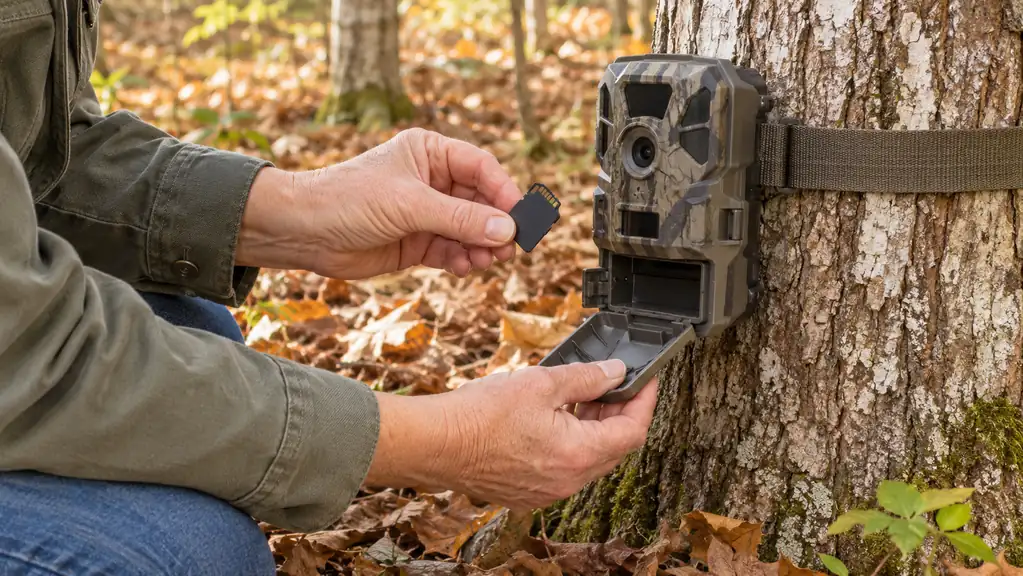
A season on the back forty means fall 2025 for me. I put the camera on the white oak in August 2025 and checked it every two weeks through the fall. The walk from the gate to that tree is not long, but it is long enough that I do not go every day. I pull the card, put a fresh one in, and check the batteries while I am there. Then I walk back and look at the photos on the laptop. That is the whole job. If you want live pictures, this is the wrong tool. If you want a record of what crossed the creek, it does that.
The checks themselves are nothing to write about, which is a compliment. One morning in late October I walked out before light with the headlamp on red, knelt at the base of that white oak, and had the card swapped before my knees complained. Fog sat in the bottom and the leaves were wet. I checked the batteries while I was down there and closed the housing back up. Then I walked to the gate with a full card in my shirt pocket. By the time I had coffee, I knew what had crossed the creek.
In October 2025 the camera caught an eight-point buck at the creek crossing. At night. Not once, but several times over a couple of weeks. I had never seen him in daylight, and I never did. The camera never did either. He was a night animal on that crossing, and the card was the only proof he was there. I did not shoot him. Nobody did, as far as I know. That is the honest end of the story. A trail camera can show you a buck and still not put him in front of you during legal hours. It tells you what is around. It does not tell you what to do about it.
The camera also caught does, fawns, raccoons, and one coyote I would just as soon not have around. That is the ordinary work of a camera on a creek crossing. The one deer I took in 2025 was at the gate post, 96 yards from the stand, in November 2025. The camera did not see that deer. It watches the creek crossing, and the gate post is not in its view. That is the limit of one camera on one tree. It does not see the whole back forty. It sees one spot, and you have to be honest with yourself about which spot you need.
The eight-point buck was on the card in October 2025, at night, several times. I never saw him in daylight, and the camera never did either.
The Night Photos: Where It Earns Its Keep and Where It Doesn't
The night photos are the reason I bought a camera at all. The WOSPORTS uses 850nm infrared, and the night pictures come back black and white. At the creek crossing, a deer close to the camera is clear enough to count points. The eyes shine, the body is solid, and you can tell a doe from a buck. That is enough for me. I do not need a color portrait at midnight. I need to know what is using the crossing when I am not there.
What nobody tells you about night photos is motion. A deer standing still is one thing. A deer walking is another. The infrared light and the shutter do not stop movement, so anything on the move comes back as a smear with legs. I have a dozen photos of a dark shape that could be a deer or could be a dog, and the honest answer is that I cannot tell. The camera has a PIR motion sensor and a fast trigger response, and it catches animals, but catching them and identifying them are two different jobs. If a clean night photo of a moving animal matters to you, this camera will disappoint you sometimes.
One raccoon in September made that point plainer than I can. He came through the shallows below the crossing on a wet night, and the camera caught him in eleven frames. In four of them he was still enough to see his face and the rings on his tail. In the other seven he was a gray shape with one bright eye. I kept the four and deleted the rest. If you want every frame to be a portrait, you will delete more than you keep.
The infrared does not reach the far fence. Nothing does. The far fence is 212 yards from the stand, and the camera is in the creek bottom. It is not a spotlight and it is not a long-range unit. It sees the crossing. If a deer steps off the trail and stays in the dark beyond the IR, you get a pair of eyes and a suggestion of a body. That is the trade. You get a small camera on one tree, and you get the range that comes with it.
The Limits Nobody Mentions
The biggest limit is the one I already named: no wireless. The connectivity is the SD card, and the compatible device is a laptop. There is no app, no Wi-Fi, no cellular. You walk out, you pull the card, you put it in a laptop. If you live an hour from your ground and you only get there once a month, you will miss things. A cellular camera would send pictures to your phone, and this is not that. I knew that when I bought it. I am telling you now because the listing does not make a fuss about it.
The camera runs on batteries. That is the power source, and it is the ordinary upkeep of a camera like this. I check them when I pull the card. In cold weather they do not last as long, and I keep a spare set in the truck. The camera has been through rain and fog, and it has kept working, but I do not leave it out for months without checking. A camera you forget about is a camera that quits and you do not know it. The two-week card pull is also a battery check, and that is on purpose.
Framing is the other thing nobody mentions. The first card I pulled had a lot of empty water and a deer trail clipped at the top edge of the picture. I went back out, loosened the strap, and tipped the housing down an inch or so, and the next two weeks were twice as useful. The camera did not change. The aim did. Any camera on a tree will do this to you once, and the fix is one more walk out, not a new camera.
The housing is ABS plastic and the water resistance is listed as water resistant. I have said that twice now, and I will say it once more: water resistant is not waterproof. The title says waterproof, and I understand why a listing does that. The spec sheet is the more careful document. I treat the camera like a tool that can handle weather, not like something I can throw in the boat bilge. It is 11.68 ounces and small, and it has stayed on the tree through some wet mornings. That is my experience, not a guarantee for yours.
What I Liked
- 30MP daylight photos show detail on a deer at the creek crossing.
- 850nm infrared gives usable black and white night photos at close range.
- Compact and light at 4.25 by 4.21 by 3.43 inches and 11.68 ounces, easy to strap to a white oak.
- Push-button controls and SD card mean no account, no app, no signal.
Where It Falls Short
- No wireless. Every check is a walk and a card pull.
- Water resistant, not waterproof, despite the title.
- Night photos of moving animals blur.
- It watches one spot. The gate post and far fence are outside its view.
Who This Is For
This camera is for the person who has one trail, one crossing, one tree, and does not mind a walk. If you already go to the stand or the creek every couple of weeks, the card pull is part of the trip. You will strap it to a white oak, set the push buttons once, and check it when you check everything else. The WOSPORTS camera is plain, and plain is the point. It does not ask for an account or a signal. It asks for batteries and a card.
It is also for someone who wants to see what uses a creek bottom without a cellular plan every month. I am not against cellular cameras. I just do not need one on 40 acres I can walk. The camera shows me does, fawns, raccoons, the occasional coyote, and one eight-point buck I never saw in daylight. That is worth the walk to me. If it is worth the walk to you, this is a sensible first camera.
Who Should Skip It
Skip it if you want a picture on your phone from the house. Skip it if your camera is a mile from the truck and you only go once a month. Skip it if you need to watch a fence line 212 yards long. This camera sees a crossing, not a fence line. Skip it if you will not read your state's rules on trail cameras, hunting hours and limits. I keep mine on my own ground, over a creek crossing, and I do not point it at a house or a road. You should do the same or know why you are not.
Skip it if you need a waterproof camera to leave in a wet spot for months without checking. It is water resistant. Skip it if you need a no-glow infrared unit. The spec is 850nm, and I cannot tell you it is no-glow because the spec sheet does not say that. Skip it if you want 30MP photos to be sharp at 50 yards at night. They will not be. The camera is small, the infrared is close, and the night photos are honest about that.
I am not going to tell you this is the only camera worth owning. It is the one I own, on one tree, and I know its limits because I have hit them. If you want a simple camera that makes you walk out and look at the card, this one does that job. If you want a camera that sends a picture to your phone while you sit at the kitchen table, keep looking. The WOSPORTS mini trail camera has a narrow job, and it does that job without pretending to be something else.
One tree, one card, one honest look at the creek
If that fits how you check your ground, the WOSPORTS mini trail camera is on Amazon with the full listing.
Amazon See the full listing on Amazon →